
Do you remember when we thought the world was going to disappear in 2008 because scientist connected a particle accelerator? Or when the Mayan calendar marked the end of the known world in 2012? All those years, we lived a constant carpe diem “just in case” everything we knew until now really disappeared. Since we have been conscious, our generations have been under warning of impacts and situations that could have made us no longer be here, do you understand?
Space, for its part, is also to blame for this, and it never ceases to surprise us.
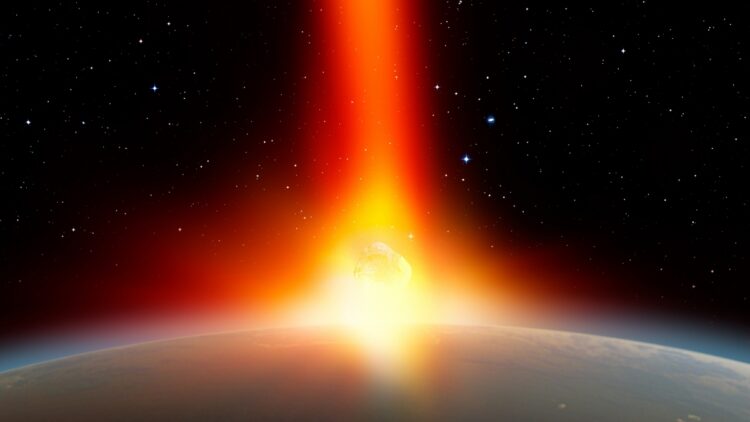
In the world of astronomy there are no breaks that are worth it, and it was on Christmas Day that some astronomers got a surprise from Santa Claus: an asteroid moving at full speed towards our planet. What a surprise for these astronomers! We tell you everything we know so far about this asteroid and what the scientific community is doing about it.
What do we know about this asteroid?
Scientists have named it 2024 YR4, and it’s about 200 feet wide, roughly the size of half a football field. Right now, it’s traveling 43 million miles from Earth, and if you think that’s a long way away… It’s not that far away, it’s like it’s a neighbour down the street. Even though it may seem like it’s very far from Earth, NASA created a list of possible objects that could hit Earth in the next 100 years (called the Sentry Risk Table), and it’s basically a ranking of asteroids in which our companion 2024 YR4 is at the top.
Should we worry?
Don’t worry, you don’t have to (yet) start saying goodbye to anyone, the chances of this rock hitting our planet are very low, about 1% chance, meaning 99 times out of 100 it would pass us by without barely grazing us. But astronomers can’t take anything for granted it because they don’t have all the data regarding this asteroid, which will be discovered as they are able to make more observations. Paul Chodas, director of NASA’s Center for Near-Earth Object Studies, has stated that if such a detection is not found, the probability of impact will simply move slowly as more observations can be added.
Why can’t science predict the trajectory of an asteroid?
Imagine for a moment that space is like one of those highways that appear in Facebook videos where there are no signs, no priorities, no direction, each car can go where and how it wants, these “cars” are actually these asteroids, and they can only move because other forces pushing them (like the gravity of the sun or the planets they approach), so predicting where a specific asteroid is going to go is very, very complicated and can only be found out (without being completely sure) with observation and calculations.
What if it crashed into Earth?
Don’t think of the worst, it wouldn’t be an apocalyptic scene or like the one with the dinosaurs, it’s big enough to destroy a city but not enough to cause a mass extinction, and we have to take into account that our planet is almost entirely made up of water and deserts, so it’s most likely that this asteroid will fall into water or unpopulated places.
There is no need to panic when these news appear, but we have to be vigilant (us too, but mainly the scientific community) because, if it represented a real danger, they would have to be the ones to implement the technology and knowledge to monitor them and try to hit them either with spaceships (to deviate their trajectory, the same thing that happened with the DART mission in 2022) or by carrying out a nuclear explosion near the asteroid to correct its route and change its course.
Astronomy is, without a doubt, one of the most fascinating and surprising sciences we know today, and our universe, like a piñata!