
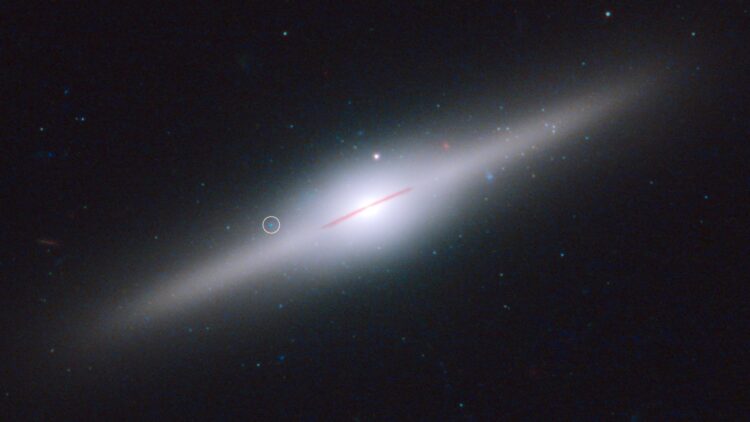
A black hole was found in a galaxy about 450 million light-years from Earth! This was something astronomers couldn’t believe because it produced a very bright flare of light, which revealed the black hole had ‘’woken up’’ from a quiet state to devour a nearby star that was too close to its powerful gravitational pull.
This is always a topic of interest among many people, experts and amateurs, and we have seen many studies about this mysterious element. However, this one is special. So, let’s find out more about what they found.
A special black hole
This special element that absorbed the star could be a rare type: an intermediate-mass one. Scientists already know two types of black holes:
Stellar-mass (small): they are born when a giant star explodes and its center collapses. It can have up to 100 times the Sun’s mass.
Supermassive (huge): they live in the center of galaxies and they are million or billion times bigger than the Sun.
However, there’s an issue: if small black holes can grow with time absorbing things, then there should exist intermediate-mass ones (between small and supermassive). Unfortunately, scientists haven’t found one yet.
What they discovered
What they found was an object called HLC-1, which was already seen back in 2009 because it emitted very bright X-rays. These are a type of light that our eyes can’t see, but special telescopes can.
In 2012, HLX-1 became 100 times brighter than in 2009. Then, in 2023, this brightness lowered. Thanks to these changes, scientists could estimate the size of the black hole behind this phenomenon.
How was it possible?
Because the more mass a black hole has, the brighter the X-rays are when consuming matter. In this case the X-rays were too intense to be a small black hole and not as intense as the ones seen in supermassive ones.
That’s why the team led by Yi-Chi Chang reached the conclusion that HLX-1 could be an intermediate-mass black hole, with an estimated mass between 1,000 and 10,000 times more than the Sun’s.
What are they researching now?
Even though they saw how brightness changed, scientists don’t know yet what really happened. But they have two possible explanations:
- The mysterious element of the universe absorbed an entire star all at once and that’s why they saw the huge flare.
- The star was going around the black hole and every time it got close, the black hole took a bit of matter from it, generating flares.
Having this in mind, astronomer Roberto Soria explained that they have to keep observing HLX-1 to see if it brightens again or if its light just simply slowly disappears. He said, “Now we need to wait and see if it’s flaring multiple times, or there was a beginning, there was peak, and now it’s just going to go down all the way until it disappears.”
Importance of this discovery
If you are a universe lover, you’re not prepared for what this discovery means. I mean, scientists could better understand how supermassive black holes are born and how they grow if it is confirmed that HLX-1 is an intermediate-mass black hole, which will be obviously really important for science.
Until now, this missing piece between small and supermassive black holes has been very difficult to find, but HLX-1 could be one of the first clues to prove average ones exist.
These elements have always been so mysterious and many people are very curious about them, so this could complete the story on how these elements evolve in the universe. Wouldn’t this be so amazing?