
No calm sea ever made a skilled sailor, or so they say. Now that we’re talking about the sea… could you tell what colour the sea is? Does it depend on where you are? Or is it always blue? Green? Light blue? We know that none of us really know what colour the sea is, we know that it has light blue and light blue tones, and that if it rains it turns green, but… what if we saw the oceans of our planet from space for the first time, just as they look from up there?
Well, it has been possible thanks to the PACE satellite (Plankton, Aerosol, Cloud, Ocean Ecosystem), a satellite created by NASA that works as an inverse telescope, that is, it constantly records the Earth to see how it looks from up there.
What is PACE?
We are talking about a satellite that was launched on February 8 (2024) and that has a super special mission: to study the oceans and how the light, air and aerosols of the Earth interact with them. Its objective is not simply to portray the oceans but to know what quality of air we are breathing and how climate change is affecting the water that gives colour to our planet.
So, this satellite has photographed every corner of this planet where there is water, and the results are incredible, not only because they are beautiful images but because the sea steals the show, so much so that we understand that if we had been invaded by aliens, they would have stayed to live in the sea.
We are going to describe region by region what the PACE has captured, and you can see the photographs at this link.
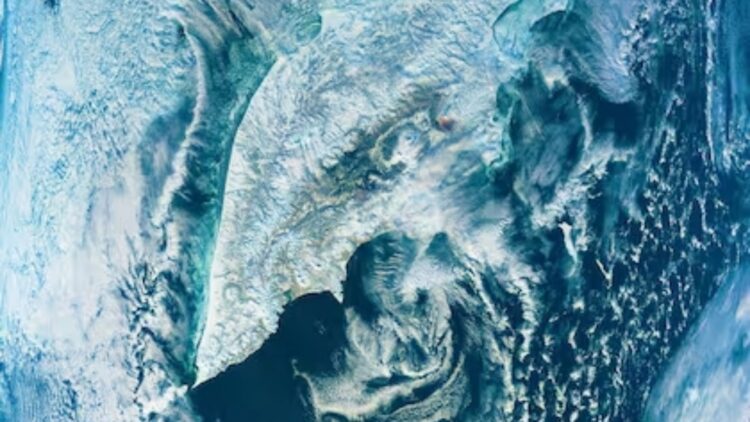
The Kamchatka Peninsula
A volcanic region located at the east of Russia, it has more than 100 active volcanoes and, from above, the PACE has managed to show a contrast between the dark tones of the volcanic terrain and the blue colours of the water
The islands of Hokkaido and Sakhalin
Between Japan and Russia we are now, the real colour of the ocean is shown with an intense blue and pieces of dark land. The PACE has also captured this area using infrared to achieve details that our eyes cannot capture with the naked eye.
The Arctic
The PACE images have put the scientific community on alert: it has been possible to see that the permafrost is releasing large quantities of carbon dioxide (CO2) than it can absorb, so it is a clear example of the effects of global warming…
Caribbean Sea
Oh, the Caribbean, this vibrant blue is due to its crystal-clear waters and the reflection of sunlight, probably the most beautiful waters in the world (and to lie on the beach toasting ourselves in the sun like cocoa, oh!)
Gulf of California:
With almost 40% of the world’s marine species, you already know that this area is a paradise of biodiversity that is home to almost 900 different species of fish! From PACE you can see a very deep green colour.
The Mississippi River
Here you can observe a phenomenon called “eutrophication”, this means that there is an excess of nutrients that reduces oxygen in the water and causes a loss of the aquatic ecosystem.
NASA and PACE are bringing us a little closer to the formation of our planet because, from above, things look much different as you can see. Thanks to this PACE mission, we will be able to better understand how our planet works and what extra care it needs! Let’s enjoy the views and make our planet the most beautiful place in the galaxy.