
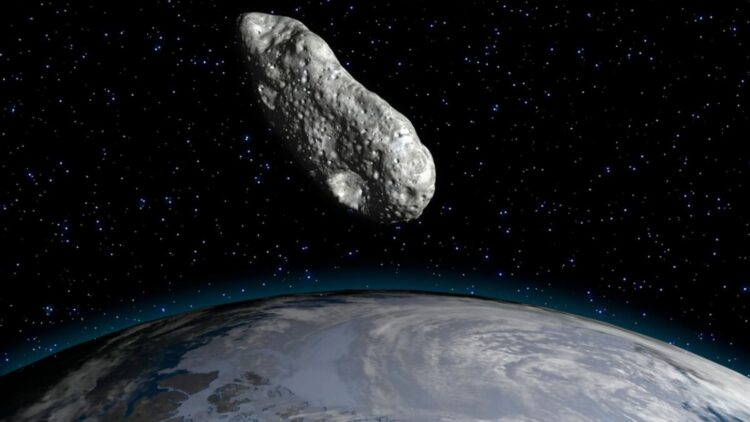
Scientists have found many asteroids, but one with the shape of a peanut? Yes, a peanut! On August 20 of 2025,an asteroid called 1997 QK1 went near Earth and it’s the nearest data since the 17th century. With more than 200 meters long, which equals 2 football fields, this object surprised scientists for its unusual shape of a peanut and its fast rotation. The discovery offered a unique opportunity to closely study such a weird cosmic visitor. So, let’s find out more about this asteroid.
A weird asteroid
It’s not everyday when an asteroid gets so close to our planet Earth after more than 3 centuries. Taking advantage of this moment, NASA used a planetary radar in California to observe it in more detail. After one day of this asteroid journey (the 21st of August) the Goldstone Solar System Radar, which is part of NASA’s Deep Space Network, obtained images with a resolution of up to 7.5 meter per pixel.
‘’Cosmic peanut’’
The images revealed that the asteroid is not a simple rock, it’s a ‘’contact binary’’. This means that it’s formed by 2 lobes joined together as if they were two masses of rubble pressed into one. One of the lobes is nearly double the size of the other, and both show concave areas and craters as deep as several buildings.
Even though it can seem strange, it is not an isolated case. According to NASA, around 15% of asteroids near Earth with this size have similar structures. They are remains of the primitive solar system, pieces that never became planets and that, after billions of years of collisions and soft joints, adopted these peculiar shapes.
How near it was?
The 1997 QK1 happened about 2 million km of distance, which is 8 times the distance between Earth and the Moon. Although it seems a lot, in astronomic terms it is considered relatively close. In fact, it had not come this near since over 350 years ago. Thanks to this proximity, scientists could define several features:
- Length: about 200 meters.
- Rotation: one full spin every 4.8 hours.
- Classification: a “potentially hazardous asteroid,” although NASA confirms it poses no threat “in the foreseeable future.”
Importance of this
An asteroid like the 1997 QK1 is more than a simple rock that floats on space, and study them is crucial for several reasons:
- History of the solar system: asteroids are remnants of the solar system’s formation. So, analyzing them allows us to understand the materials and processes that gave birth to planets, including Earth.
- Planetary defence: Even tiny objects can cause damage. The meteorite that exploded in 2013 over Chelyabinsk (Russia) was barely 20 meters and caused widespread shockwaves and injuries. That’s why knowing whether an asteroid is solid or a loose collection of rubble changes how scientists might try to deflect it in the future.
- Preparation for the future: Data like the one from the 1997 QK1 allow scientists to improve strategies of study and asteroid deviation. NASA’s recent mission, DART, which achieved modifying the asteroid’s orbit with a controlled impact, proves how important it is to have precise information.
A vision toward the future
This won’t be the last encounter with 1997 QK1. According to NASA, the asteroid will go relatively near Earth in 2039, even closer: about 2.4 million km. This proximity will offer a new opportunity to investigate it and could even motivate the design of a more ambitious mission to closely explore it.
So, the year 2039 (14 years from now) will be full of discoveries of more mysteries about this peculiar visitor. Are you excited already?