
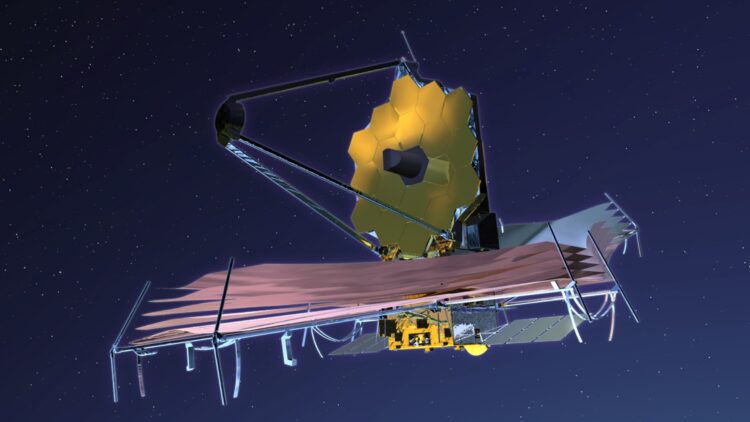
NASA and the James Webb Telescope have once again taken the spotlight in space exploration. This time, it has shown us what is happening 111 light-years from Earth, in the Hydra Constellation. A possible planet, 100 times more massive than ours, at 47 degrees Celsius, orbiting TWA 7 (a young star). If confirmed to be a planet, we could be at the beginning of a new era of exoplanet exploration through direct imaging!
Are we facing the first direct evidence of a Trojan disk, or a dust cloud trapped in the orbit of a planet?
TWA 7b: a new planetary candidate
It was the astronomer Anne-Marie Lagrange from the Paris Observatory and the University of Grenoble Alpes who discovered this planet. A system located at a distance from its star 50 times greater than the one between Earth and the Sun.
All thanks to MIRI
The MIRI instrument on the James Webb was crucial for this breakthrough. Thanks to its coronagraph, astronomers were able to see through the star’s intense light and detect a faint thermal signal that stood out among the dust, there was this planet TWA 7b. Thanks to MIRI, astronomers were able to remove the visual noise and reveal details that had gone unnoticed by other telescopes.
What is a Trojan disk?
A Trojan disk is a buildup of dust that gets trapped in stable points within a planet’s orbit. And even though we could imagine them because they had been simulated by computers, until now there was no real evidence or images of this phenomenon. So we are looking at the first real evidence of this type of cosmic formation.
A young star with a story to tell
TWA 7, also known as CE Antliae, is a star only 6.4 million years old, a baby in astronomical terms!
Its nearly face-on orientation with respect to Earth and its youth make James Webb keep watching it with its infrared sensitivity!
What do scientists say?
Anne-Marie Lagrange considers this breakthrough a “crucial step” in understanding how planets form around young stars. Meanwhile, Mathilde Malin, co-author of the study from Johns Hopkins University, has stated that this type of finding opens a new door to exploring planetary systems in formation. And it does.
Still to be confirmed
Although the data is promising, scientists warn that it still cannot be 100% confirmed that this is a planet. It could be a fleeting anomaly or a more distant object that just happens to be aligned with TWA 7. However, the location, thermal brightness, and stability of the object clearly suggest that TWA 7b is a world in formation, and we are going to be able to see it from Earth!
Why this is important for NASA
Because science needs to know more, and so do we! The usual questions, how did we get here, how was our planet formed… Now this discovery could help answer that.
Normally, exoplanets are discovered by the effect they have on their stars, but seeing them directly, like in this case, is like turning on a flashlight in the middle of a light storm. This is an unprecedented scientific and technical achievement, and all thanks to the James Webb!
In the coming months, the telescope will continue observing the system to confirm the nature of this object. Theories and simulations, thanks to James Webb, we are learning a little more about how the universe was formed, and we are getting closer to knowing how we got here!
And, who knows, maybe one day we will discover that we are not as alone as we thought. Our universe is incredibly amazing, and we are just a little piece of it! Which will be the next discovery?