
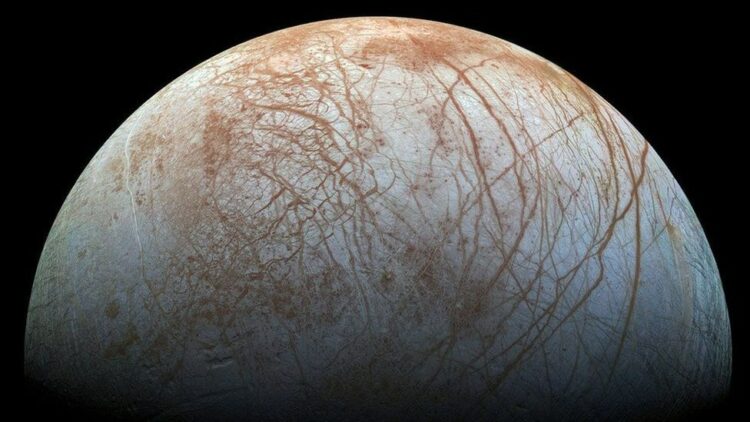
Perry? Perry the Platypus? No! Not this time at least, but it looks like him. NASA has been investigating what happens more than 500 million kilometres from Earth, and many have been tremendously surprised. They’ve found something that seems to have come from another planet… literally, we’ll tell you about it now! Scientists have been investigating photos taken by NASA’s Juno spacecraft, which, as you know, has been studying Jupiter, its components, its storms, and, above all, its moons. That’s where Europa, the focus of this article, is located.
What is Europa?
Europa isn’t just a continent; it’s also one of Jupiter’s most fascinating moons. It’s a giant ball of ice that hides a subterranean ocean beneath its icy surface. Scientists believe this ocean could have the right conditions for life. Imagine a world where, instead of land and mountains, there’s a crust of ice with liquid water underneath, moving like a shadowy ocean. That’s why space missions are obsessed with studying it: if we find life there, it would change everything we know about the universe, how intriguing!!
What have they seen now on Europa?
Incredibly, scientists have discovered a kind of formation they’ve named “the Platypus” (like the animal). But what’s so special about this structure?
What makes Europa so special?
As we said, it’s one of the most fascinating moons in the solar system. Although it’s slightly smaller than our Moon, it has characteristics that have the international community in suspense. Many astronomers and physicists believe it hides a vast global ocean beneath its 18-kilometer-thick layer of ice. And if there’s water there, there could be life! That’s the conclusion our astronomers want to reach: to find life in these water formations. Can you imagine what living beings on Jupiter might be like?
The mysterious “Platypus”
NASA’s team got a very pleasant surprise when Juno imaged a chaotic area on Europa’s surface, specifically a region filled with ridges, ice mounds, and dark reddish material. Amidst all this, they found a peculiar structure measuring about 37 x 67 kilometres that looked like a mosaic of fractured ice, with areas where water could have escaped and refrozen. They named it “the Platypus” because of its strange and unique shape.
But that’s not the most striking thing. A little higher up than this formation, scientists found a double ridge with dark spots, suggesting that there could be saltwater deposits coming from the subterranean ocean. In other words, Europa could be spewing water from its depths. This is incredible news for science because it would give scientists the perfect opportunity to study what lies beneath its icy shell without having to drill into it!

So what now?
Juno isn’t the only mission with its eyes on this enigmatic moon. In the coming years, two key missions will arrive: NASA’s Europa Clipper, which will take off in 2024 and arrive in 2030, and the European Space Agency’s JUICE, which departed in 2023 and will reach its destination in 2031. Both will explore Europa’s surface and composition in search of signs of oceanic activity there, because, as we said, Europa may hold the key to finding extraterrestrial life; we have many indications that there is water within its harsh atmosphere!
Extraterrestrial life could be getting closer, and we’re closer to knowing whether “aliens” look more like E.T. or aquatic creatures. How do you imagine them?