
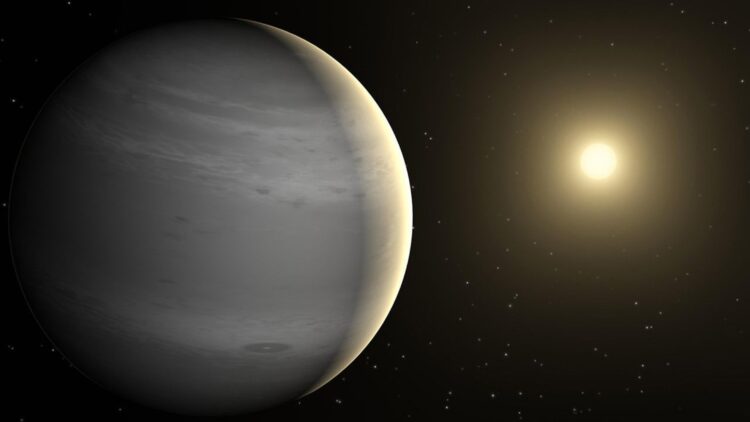
A group of NASA scientists have made a historic discovery: for the first time, they have detected a baby planet inside a huge ring of gas and dust that’s 437 light-years from Earth. This discovery helps astronomers better understand how planets are formed in the universe, which is one of the most ancient questions about science. So, let’s find out how scientists got to discover this phenomenon that’s crucial for science.
How planets are formed
One of the curiosities about astronomy is understanding how planets are created. Scientists notice that, around young stars, there are protoplanetary disks – which are rings of gas and dust that turn around the star.
In these disks the particles of dust and gas collide and stick together, forming larger bodies. With the passage of time, these bodies may become planets or other structures of the planetary system.
For decades, astronomers have theorized that planets might form in the gaps of these disks. However, the density and chaos of the material made it extremely difficult to detect or observe planets in formation—until now.
NASA and the discovery changing science
Recently, NASA has detected a baby planet called WISPIT 2b inside one of these protoplanetary disks. The discovery was led by Laird Close, from the University of Arizona, and Richelle van Capelleveen, student at Leiden Observatory in the Netherlands.
The disk is called WISPIT 2, which contains a system of rings of gas and dust. Scientists first observed the disk using VLT-SPHERE, a telescope in Chile, and then used MagAO-X, an advanced optics system at the University of Arizona, to take a high-resolution image of the baby planet.
Facts about WISPIT 2b
Now that we know the name of the discovery, let’s learn more about it, shall we?:
- It is a giant gas planet still growing in its protostellar stage.
- It has about 5 times the mass of Jupiter.
- It is roughly 5 million years old.
- It is located 437 light-years from Earth.
Another discovery
While exploring the WISPIT 2 disk, astronomers also found another point inside a nearby disk (possibly planet forming). The thing is that its exact nature is unknown and NASA has decided to postpone investigation for future studies, but it may lead to further discoveries of baby planets.
Importance of this discovery
This finding has been considered revolutionary because it allows scientists to:
- Observe a planet in its earliest stage, something previously only theorized.
- Explore other protoplanetary disks to find more baby planets.
- Improve detection of exoplanets that are difficult to see inside or outside our solar system.
- Use advanced tools like VLT-SPHERE to capture high-resolution images and monitor planets as they grow over time.
This means NASA now has the opportunity to study thousands of exoplanets in their early stages, helping scientists understand how planetary systems, including our own, were formed.
So…
The NASA discovery of WISPIT 2b, the first baby planet observed within a protoplanetary disk, marks a major advancement in science. For the first time, astronomers can see a planet in its very early stage, confirming theories about how planets form.
It also opens the door to exploring other disks in space to find new planets in development. So, this baby planet is a crucial piece in understanding the birth of planetary systems and sets the stage for future scientific discoveries in astronomy.
Isn’t it incredible how many things we don’t know about outer space? Imagine what scientists may discover in 10 years time with all the technological advances and these findings they can use as guidance.