
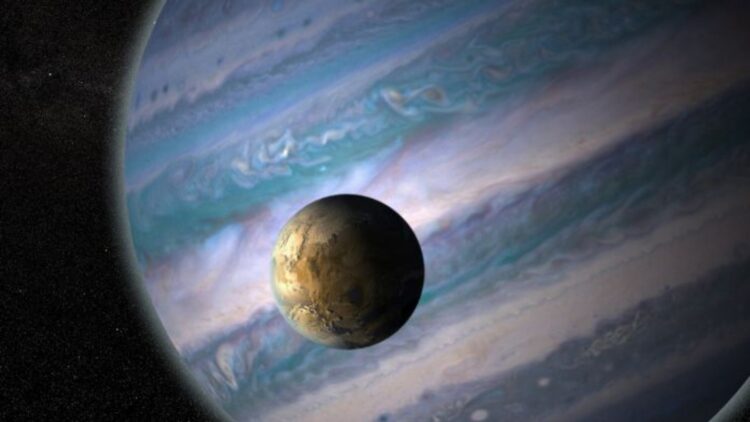
NASA believes that life beyond Earth may be found not on another planet, but on a moon: and the first candidates are already in the sights of the entire scientific community. Although no exomoon has been confirmed yet, scientists are convinced they exist and have already detected the first signs. The top candidate to become the first official exomoon is called Kepler 1625 b-i.
The search is not new, but it is now becoming serious. So far, only exoplanets have been confirmed, more than 4,000 in total, but not a single exomoon has been detected with certainty. Still, the scientific community has no doubt: if there are planets outside the Solar System, there are also moons orbiting them. And some could even have conditions similar to those that allowed life on Earth. We know we’ve shocked you with this information, so let’s try to explain it all below.
Invisible moons that could change everything
The existence of exomoons is not just a numbers game. They would be key to understanding how other planetary systems form, how they evolve, and whether there are truly habitable environments beyond Earth. But the reality is that none has been detected yet, though techniques have been developed to find them. One of these techniques is based on the transit method (also used to find exoplanets), where the intensity of light received from a star is measured, and if a planet orbits around the star, we’ll receive less light because the planet will eclipse part of that light.
How to search for something that cannot be seen
If that planet has a moon, the pattern changes, even if it’s subtle. The movement of the planet is also observed: if its centre of mass or the duration of the transit changes, it could indicate that it has a moon hanging on.
So far, all these signs are small clues, but one stands out above the rest.
How to know if there is life
Once we are able to detect exomoons, the next step will be to look for those with conditions that could harbour life. Even though we don’t know what exomoons are like, logic leads us to think that their characteristics must be similar to those of our planet.
Exomoon formation options
It is believed that there are two main options for exomoon formation. One of them is through accretion disks around gas giants, meaning they were engulfed by the planets due to gravitational attraction.
But then there’s Triton, Neptune’s main moon, which is believed to have formed through tidal disruption. It’s thought that Neptune “encountered” a binary planet in the past, and Neptune’s tidal forces expelled one of the bodies, capturing it into its orbit.
Kepler 1625 b-i: the first major candidate
It is about 8,000 light years away and, according to astronomers, could be the size of Neptune. Its transit shows variations that don’t match what would be expected from just a planet. There’s still no official confirmation, but if it’s eventually proven to be a moon, we would be looking at a historic discovery.
How would life arise?
We have no certainty that life can be out there, but we must be clear that there are certain requirements that are essential for life to form: energy and complex molecules that form living beings.
When could we confirm it?
The key year will be 2029. The Ariel mission, from the European Space Agency, will analyse the atmospheres of exoplanets and could detect chemical signals that only make sense if there’s life. It won’t be necessary to land. Just looking from afar… and knowing what to search for.
We’ve always looked at planets, thinking we would find life there. But more and more scientists believe the answer might be on a moon. A moon we can’t see, but which could have water, heat, and the key ingredients for life.