
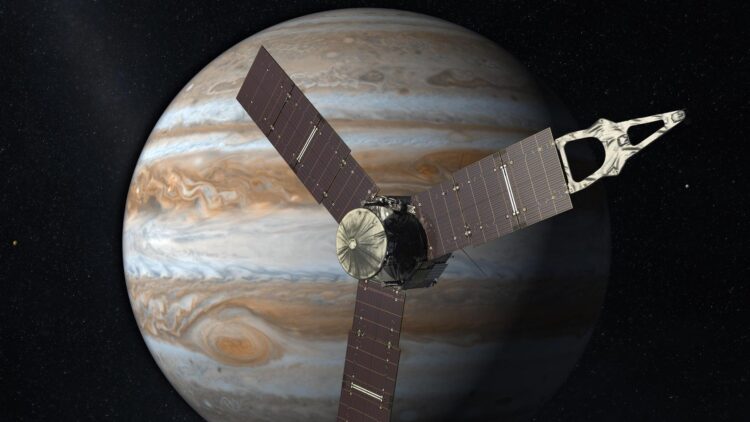
Imagine trying to fix a broken camera… that’s almost 600 million kilometers away. Sounds impossible, right? But that’s exactly what NASA managed to do with JunoCam, the camera aboard its spacecraft orbiting Jupiter. In the vast emptiness of space, where no repair crew can be sent and every decision takes hours to reach its destination, NASA pulled off a high-stakes remote fix — using nothing but heat. So, let’s see how they saved the camera, what they learned, and what it means for the future of space missions.
What happened to NASA’s Juno spacecraft camera?
NASA has a spacecraft called Juno, which was sent several years ago to the planet Jupiter, the largest in the solar system. This spacecraft is orbiting the planet to study it up close.
One of the most important parts of Juno is a special camera called JunoCam. This camera takes pictures in visible light (like what our eyes see) and allows scientists and the public to see amazing images of Jupiter and its moons.
What problem did the camera have?
When NASA built the spacecraft, they thought that JunoCam would only last about 400 days. That equals about 8 orbits around Jupiter. Why such a short time? Because the camera is outside the radiation-protected compartment, so it’s more exposed to the strong radiation coming from Jupiter. However, the camera surprised everyone and worked well for 46 orbits.
But when Juno began its 47th orbit, the camera started to show problems. The images came out with errors, as if they were damaged. According to the scientists, the problem was probably damage caused by radiation, which affected a part called the voltage regulator, which helps control the electric power the camera receives.
Can it be repaired from Earth?
No. The Juno spacecraft is almost 600 million kilometers from Earth. So, there is no way someone could go there and change a part or do a physical repair.
What solution did they try?
The scientists at NASA’s Jet Propulsion Lab tried something called “annealing”, a process where parts of the camera are heated up and then they let them cool down. Sometimes, doing this can help fix tiny damage inside, like the kind caused by radiation.
So, they sent a remote command to the spacecraft, telling it to switch on the camera’s internal heater. The temperature was raised to about 25°C (77°F) — noticeably warmer than what the camera is used to. After heating it, they waited… and it worked. The camera started taking clear and sharp pictures again. After heating it, they waited… and it worked. The camera started taking clear and sharp pictures again.
Was it fixed for good?
Not completely. After some time, the image quality went down again. The photos came out bad once more. They tried processing the images in different ways, but nothing worked.
Then they decided to try another heat cycle, this time at a higher temperature (though they didn’t say exactly how much). And again, the heat worked, just in time for the camera to take pictures of Jupiter’s moon Io at the end of 2023.
What did NASA learn?
Thanks to this experiment, NASA discovered that this technique of using heat to fix internal damage caused by radiation can be useful in other parts of the spacecraft, not just in the camera.
Even though they didn’t say if all the other tests worked, the mission’s lead scientist, Scott Bolton, explained that they are learning how to build and maintain spacecraft that resist radiation better.
This could help in the future not only with other NASA missions but also with defense satellites, commercial satellites, and even satellites orbiting Earth, because they also receive some radiation.
And now? Is the camera still working?
The camera kept taking good images until Juno’s 74th orbit. But after that, errors in the images appeared again. For now, NASA hasn’t said if they will try heating it again, or what decision they will make about the future of JunoCam.
Fixing a space camera with heat alone might sound like science fiction, but NASA made it real. Against the odds, engineers brought JunoCam back to life not once, but twice, from hundreds of millions of kilometers away. While the future of the camera is uncertain, the mission has already proven something big: even in the harshest environments, smart thinking and bold ideas can keep our eyes in space open. And the lessons from Juno? They’re just beginning to shape how we’ll explore — and protect — the machines we send to the stars.