
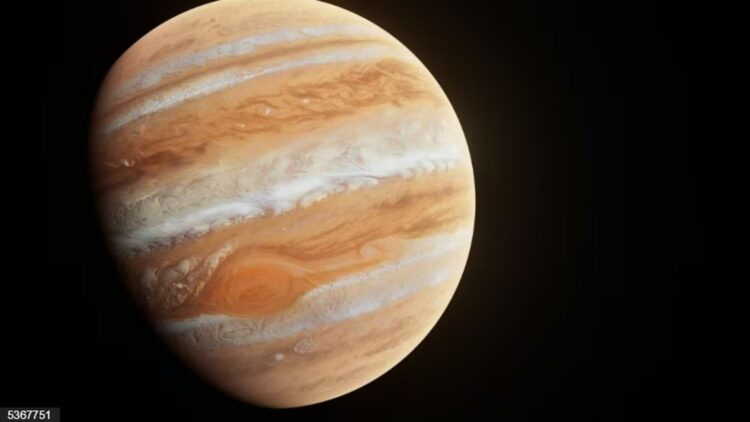
NASA continues to explore everything beyond our atmosphere. Recently, they’ve been studying Jupiter, and the first thing that comes to mind when we think of this massive planet is its iconic Great Red Spot, right? That gigantic storm has been raging for centuries on the largest planet in our solar system, still capturing the attention of the astronomical community. However, this time, it’s not the storm stealing the spotlight: it’s one of Jupiter’s tiny moons.
While orbiting the planet, the Juno spacecraft made an incredible discovery. The focus is now on Amalthea, a small moon just about 100 kilometres wide that has caught astronomers’ attention due to its intense red colour. And in space, nothing is random! Scientists believe its reddish hue is influenced by sulphur ejected from Io, one of the most volcanically active moons in the solar system. Want to know more about these fascinating moons? Keep reading!
What is Amalthea?
One of the most peculiar moons in the solar system. It was first observed in 1892 by Edward Emerson Barnard, and unlike the spherical moons we usually picture, its shape is more like a misshapen potato. Why? Simple, its gravity isn’t strong enough to mold it into a round form.
Amalthea orbits extremely close to Jupiter, within the path of Io and other small moons like Metis, Adrastea, and Thebe. In fact, it completes a full orbit around the planet in just 12 Earth hours.
Why is it special?
The most fascinating thing about this tiny moon is that it emits more heat than it receives from the Sun, it is not just a red spot on Jupiter’s sky. Why? There are several theories, but the most popular ones suggest it could be due to Jupiter’s magnetic field, which generates electrical currents inside the moon, or the planet’s gravitational force, which creates friction in its core.
And this moon was seen again while the Juno probe flew about 265,000 kilometres above Jupiter’s cloud tops, during its 59th mission.
What is Juno?
Juno is a NASA space mission that seeks to learn more about the secrets hidden in Jupiter’s environment. It was launched in 2011 and has been orbiting Jupiter for more than seven years, studying and analysing important data such as its atmosphere, magnetic field, and moons. JunoCam, the probe’s main instrument, not only captures high-quality images but also allows other scientists to process the photographs and participate in the selection of future observation targets, so it’s something of a team effort.
For some time, Juno has captured incredible images of Jupiter, showing deep-sea winds and the presence of spectacular auroras at its poles. These images of Amaltheas were taken as the probe passed 265,000 kilometres above Jupiter’s cloud tops.
What will happen to Juno?
Unfortunately, Juno’s days are numbered. Although its mission ended in 2021, NASA decided to give it a little longer to continue exploring Jupiter’s moons and atmosphere as long as its batteries last… When this happens, Juno is scheduled to enter the planet’s atmosphere and disintegrate completely to prevent it from contaminating its moons (because some could harbour microscopic life, wait what?!)
The image of Amalthea crossing in front of the Great Red Spot is much more than just a pretty picture. There are still many mysteries to be solved in the solar system we inhabit, and each space mission brings us a little closer to understanding how our universe works. Isn’t that incredible? So the next time you look up at the sky, remember that, somewhere millions of miles away, a small, lonely spacecraft is still sending us clues about Jupiter’s secrets!