
Space is a huge place full of mysteries, but it seems that every day we are learning more and more things that bring us closer to the reality of our system. For decades, astronomers have been trying to collect all the information hidden about the universe, but now, there is a NASA computer that is stealing the show: it has discovered that the Oort Cloud could have spiral arms. Ok, but what does this mean? Let’s tell you right now!
What is the Oort Cloud?
Let’s take it one step at a time, the Oort Cloud is like a space graveyard, a very distant and icy region where many fragments of rock and ice are found. It is so far away that the Voyager 1 probe (the most distant object sent by mankind) will take more than 300 years to reach its interior, because it extends from 2,000 to 100,000 AU (astronomical units) from the Sun. Let’s put it in context, one AU is equivalent to the distance we are from the sun (about 150 million kilometres!!), so we are talking about something that is extremely far away from u
This cloud is believed to have formed 4.6 billion years ago, at the same time as our solar system, when the giant planets (Neptune, Jupiter and Saturn) expelled materials out of our solar system, and over the years these rocks were organized in a bubble around the sun. It is so far away that no telescope has been able to photograph it directly, so all we know about it is from information coming from some comets.
So no, there wasn’t much of a record of what the actual shape of this Cloud looked like. But now scientists have developed a new model that could explain that this cloud is more like a mini-galaxy that has spiral arms.
And how did they discover this?
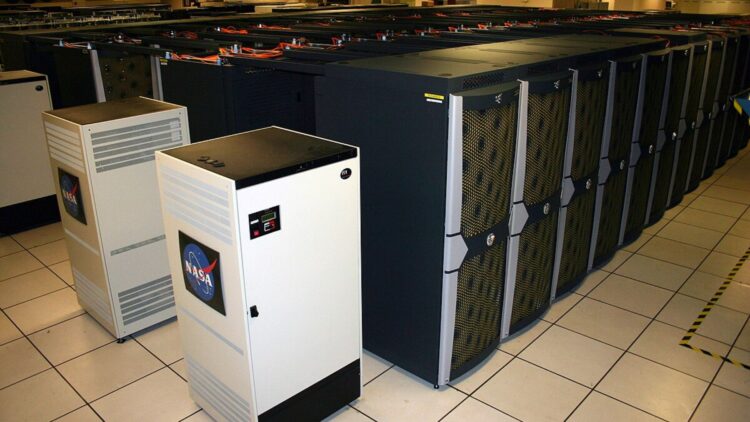
As always, NASA has an ace up its sleeve, and has used the Pleiades Supercomputer. If you’re wondering what this supercomputer is, it’s basically NASA’s brain, a giant computer that processes huge amounts of data and calculations to run simulations for future space exploration projects. It’s a real breakthrough because it saves NASA scientists thousands of hours and can design rockets at breakneck speed (and without the need to physically build them!!) In addition, it receives information directly from Artemis or the James Webb Space Telescope and analyses it on the fly.
They have introduced all the data they had until now about the orbit of comets and the effects that other bodies exert on the Oort Cloud, and when Pleiades finished its calculations it revealed something that surprised the whole community: a spiral structure just as the Milky Way is formed.
What does this mean?
It means that the Oort Cloud is not just a ‘chaotic cluster of debris’ but could have a structured organisation thanks to the influence of the galaxy’s gravity and other nearby stars! But how could such a distant structure have this shape? The answer could lie in a phenomenon called the galactic tide.
What is the galactic tide?
It has nothing to do with oceans but it has to do with the way galaxies influence objects around them, which would explain why some comets coming from this Cloud reach our solar system: because they can launch objects into other parts of the galaxy.
Voyager 1: what role does it play in this story?
It was launched in 1977 and still has more than 200 years to go, unfortunately we won’t be able to live through it (or we will, who knows), but it will be the scientists of the future who will be in charge of analysing the data found in this cluster of icy rocks, but for that there are still many studies to be done on its interaction with our solar system!