
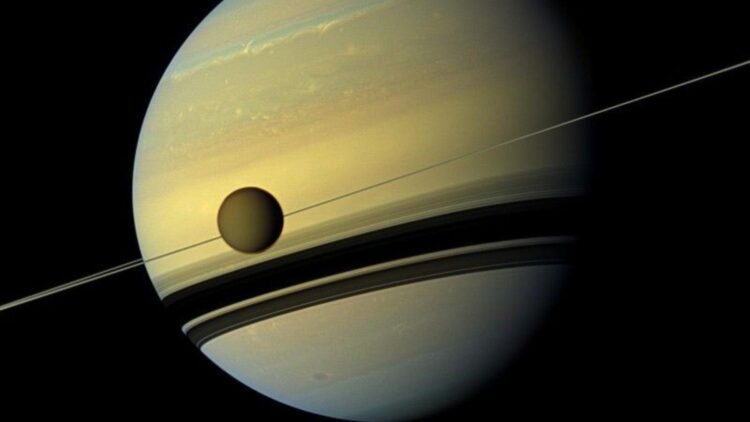
This new scientific discovery about Titan has shocked scientists! Can you imagine a frozen moon with some sort of life? Researchers at the University of Arizona couldn’t believe the clues they got from Saturn’s moon, Titan. They have used bioenergy models to explore whether extraterrestrial life could survive in Titan’s underground ocean, a place scientists have been fascinated with.
What makes Titan different from other parts of the solar system is its thick atmosphere full of methane, and the fact that its surface has rivers and lakes made of liquid hydrocarbons. Scientists believe that if any life exists in Saturn’s moon, it might survive using a process similar to fermentation, like certain Earth bacteria. Extraterrestrial life has always been a popular topic among citizens and scientists, so let’s find out more about what NASA found about Titan!
What’s happening on Titan?
Titan is Saturn’s biggest moon and it is being the talk of the town at NASA because of the possibility of life in its underground ocean, but in a very different way from what we might imagine that life would be. Scientists believe life, if any, in this place is so little that its entire ecosystem could weigh the same as a miniature poodle. That’s so small!
Life evidence
Now that we know Titan has an underground ocean under its frozen surface, it’s also important the fact that this moon is formed by methane and nitrogen. Once exposed to the sunlight, these elements create organic molecules that fall into the surface and could reach that underground ocean. What do I mean by organic molecules? Well, these are the basic ingredients for life, like the ones found in asteroids or satellites.
Microbes living in Titan’s ocean
A group of scientists, led by Antonin Affholder, decided to answer the question on whether microbes could live in Titan’s ocean. To come up with an answer, they studied if these organic molecules that reach the underground ocean could feed microbes.
They were thinking about a type of microbe that uses a process called fermentation to obtain energy. Instead of breathing oxygen, this microbe would break a simple molecule called glycine (an amino acid found in many places of the universe) to survive. This process is similar to the one bacteria on our planet do to help make, for example yoghurt, bread or beer.
How much life?
The most striking aspect about this discovery is the fact that Titan’s entire biosphere (all its life) might weigh just a few kilograms, and there might be less than one microbe per liter of ocean water. What’s more, all the life together would contain about as much carbon as a 110-pound person. Exactly, that’s super tiny!
Organic matter reaching the ocean
Scientists have two theories about how this matter reaches Titan’s underground ocean. The first one is that this matter could filter through crevices or craters caused by meteorites that melt part of the ice covering Titan. The other theory is that the matter could go up from this moon’s rocky core.
Importance of keep researching
According to the scientists, finding a cell would be like looking for a needle in a haystack. However, they do believe it is worth the try because in the case of achieving it, it would be an evidence that life could be even in the weirdest and most extreme environments. Everything requires effort, and continuing to research this topic could mean a great opportunity for further studies to find wonderful things for the future of space. Who knows what other types of lives scientists could find out there? That’s the mystery about the universe…