
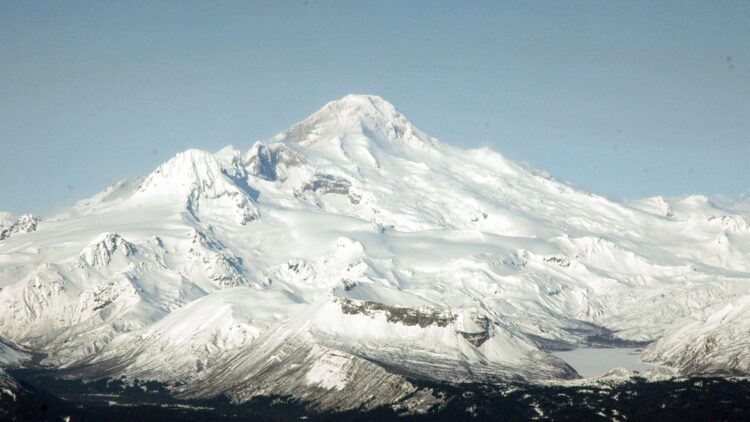
NASA has switched on the alarm again: the Iliamna volcano, in Alaska is about to erupt. Wait what? Yes. But keep calm. It’s been inactive for over 100 years! That’s exactly what they’ve seen through satellite imagery, that Iliamna is on the verge of an eruption… and it’s imminent!
We already knew there had been some seismic activity, but no one expected this volcano to return to the top of the watchlist for the moment. The most recent image, taken by the Landsat 8 satellite, shows how the glacier covering its summit could be at risk due to underlying magma activity.
What is Iliamna?
Iliamna is a volcano (considered active) located within Kenai Fjords National Park, about 210 km southwest of Anchorage. It’s roughly 10,016 feet tall, and its summit is covered by a massive glacier. And no, there haven’t been any confirmed eruptions since 1876… Looks like we’re the ones who’ll get to live through all the historic moments…
What’s happening at the volcano?
Iliamna has been off since the 19th century, more than 100 years… till now! Because that doesn’t mean it was inactive… Since June 10, 2025, the Operational Land Imager (OLI) has captured lots of images revealing changes to the glacier surface. On June 15, the Alaska Volcano Observatory (AVO) detected an increase in seismic activity, with nearly constant tremors. Is an eruption coming?
It’s all a reminder of similar past events, like the avalanches in May 2016 and June 2019.
Is it really an eruption?
The AVO has been cautious and states that even there’s been a noticeable rise in earthquakes, there’s no conclusive evidence (for the moment) of volcanic unrest underground… In other words, the movement could simply be seasonal melting, which is common this time of year, and not a direct sign of an imminent eruption, phew!
Why is Iliamna important?
Even no evacuation order has been issued yet, the fact that the volcano is so close to Anchorage makes any activity a serious concern… An eruption, even a small one, could directly impact the lives of thousands of people and disrupt the region’s ecosystems. Something similar happened on La Palma Island in Spain a few years ago… and it was terrifying…
A volcano that’s hard to predict
The combination of glaciers, avalanches, and potential magma movement makes Iliamna a particularly complex volcano to analyze. Its history is also scarce, which complicates comparisons and makes predictions harder. Experts insist that all signs must continue to be monitored using satellite tools and seismic sensors to truly determine if the nearby population is at risk.
How to prepare for a volcanic eruption?
The most important thing is to stay informed and keep calm! Our advice is to prepare an emergency kit with water, non-perishable food, a flashlight, radio, and masks. It is essential to know the evacuation routes and have a plan agreed upon with your family in case you need to leave the area quickly.
It is also a good idea to keep important documents protected and avoid approaching the volcano even if there are only steam or ash emissions.
What’s next for Iliamna?
For now, the scientific community will continue monitoring the volcano. If activity intensifies or other signs appear (like gases, deformations, or similar), measures will be taken to protect the population. But for now, nothing can be confirmed. Monitoring and preparation, just in case!
NASA satellite photo of Alaska’s Iliamna Volcano which towers more than 10,000 feet (3,000 meters) over Cook Inlet. The volcano can be seen lower slightly left of center. Regular seismic activity causes the mountain to rumble and cause avalanches. pic.twitter.com/Izz4ypKseq
— Black Hole (@konstructivizm) June 24, 2025