
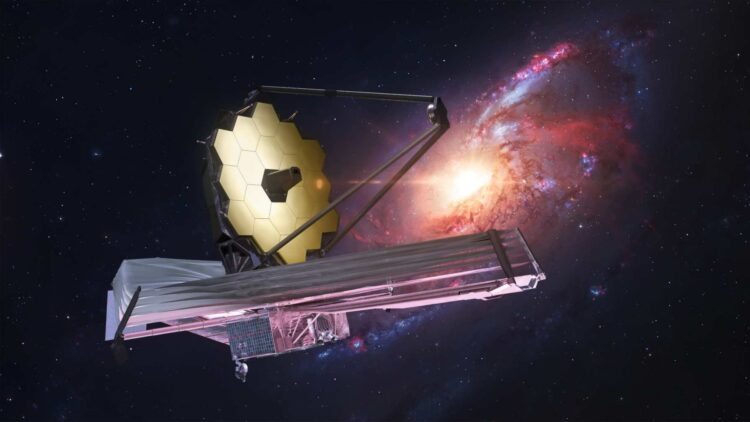
NASA never stops surprising us, and we love it! This time it’s a discovery that had never been seen before, but they have confirmed the presence of crystalline water ice outside the solar system. Do you know what that means? Yes… we already know it’s water outside the solar system, but do you know what that really means?
It was achieved, of course, by the James Webb Space Telescope, the most advanced one to date, and this discovery could change the way we understand our planets (and even life!!!).
Until now, we knew there was ice in other places like Mars, Europa or those comets that cross our sky, but we had never seen that there could be ice around other stars that are very far away from our Sun.
Where was ice found?
Our astronomers have been suspecting for many years that frozen water could be hidden in other solar systems, and now we finally have proof! This discovery was made in HD 181327, a star similar to the sun, but much younger, only 23 million years old (we call anything young these days, do its hips hurt too like ours?). Okay, jokes aside, this star HD 181327 is 155 light-years away from our Solar System (specifically from Earth), and it stands out because our sun is nothing less than 4.5 billion years old, just a bit older.
How did they do it?
Chen Xie, a researcher from Johns Hopkins University in Baltimore, Maryland, and author of the study explained that James Webb detected water ice and crystalline water ice (like the one found in Saturn’s rings) in the Kuiper Belt.
This discovery brought together the best from each place, as Spanish researcher Noemí Pinilla-Alonso, from the Institute of Space Sciences and Technologies of Asturias (ICTEA), also participated in the study.
James Webb: what is it?
It’s the most advanced space telescope ever built, a joint project of NASA, ESA, and CSA, and it was launched in 2021.
Maybe when you think of a telescope, you think of one on Earth, but this telescope is out in space, traveling to capture, through its infrared systems, everything that happens beyond our understanding of the universe.
And that’s how the Webb, with its Near Infrared Spectrograph (NIRSpec), detects icy particles that are spread along with dust grains like dirty snowballs. What really stands out to the researchers is that there’s barely any ice in the region closest to the star, but there is about 20% water ice in the outer regions, which suggests that water ice isn’t evenly distributed, or that ultraviolet radiation could be evaporating the existing ice.
And life?
Well, even though we think of water and immediately imagine the formation of organisms, there is still no discovery that indicates there’s life, but, we could be talking about the first stage of planet formation. Maybe this could teach us how water arrived on our planet, or who knows how this research will evolve!
For now, this discovery has opened the door to the idea that our condition for life may not be so rare. We came from water and up there, there’s water too. What other secrets are left to discover in the universe we live in? It’s amazing!