
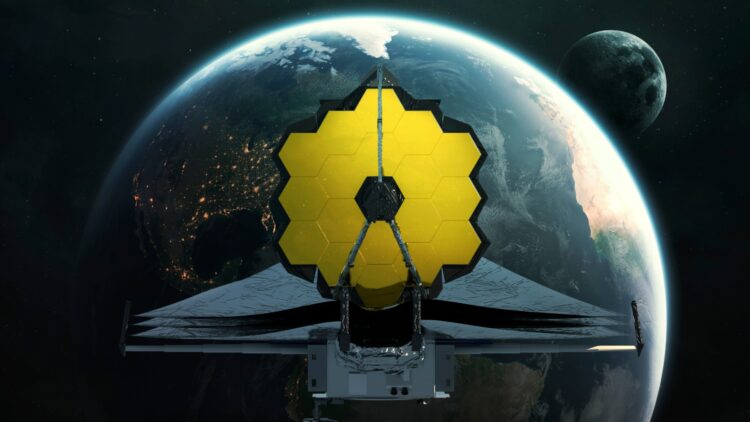
NASA has captured for the first time a direct image of an exoplanet that, according to astronomers, could be shaping the dust rings surrounding a nearby young star. All thanks to the James Webb Telescope, NASA’s hero, and the planet they’ve discovered has been named TWA 7 b. With a mass similar to Saturn and a temperature of just 47 °C, it becomes the lightest world ever detected through direct imaging!
The observation was made possible by the MIRI instrument and confirms scientists’ predictions to open a new chapter in the exploration of forming planets! That’s right, TWA 7 b is like a planetary baby! Located about 34 light-years away in the Hydra constellation, this young planet can teach us how worlds are born, isn’t that incredible?
The first planet caught in action
NASA has discovered over 6,000 exoplanets so far, but TWA 7 b is different: it was observed directly, without the need for inference through shadows or movements. Thanks to the use of MIRI’s coronagraph, astronomers managed to block the glare from the host star, TWA 7, and uncover a faint glow embedded in one of the gaps in the dust disk, that’s where our baby planet was.
The perfect moment
And it was all thanks to the planet’s exact location: right in a gap. Its brightness, colour, and distance match the characteristics of a young, cold planet interacting with its surroundings, leaving scientists speechless.
What is TWA 7 b?
For now, it’s estimated that TWA 7 b is a cold planet, about 100 times the mass of Earth, with a temperature of just 47 degrees Celsius. That makes it the lowest-mass planet ever captured by direct imaging. It also orbits a star that is only 6.4 million years old, which allows us to see planetary processes still in progress.
According to astronomers, this planet could be shaping the surrounding dust disk. Its gravity may have opened a gap within the disk, sculpting the cosmic environment of its star like a living sculpture.
The potential of a “Trojan disk”
Until now, Trojan disks (accumulations of dust trapped in a planet’s orbit) were only a theory scientists had developed on a computer, there was no proof they could exist… until now, which might be the first real evidence of their existence.
An ideal star to observe
TWA 7, also known as CE Antliae, is positioned almost face-on from our perspective, which makes it easier to observe with infrared telescopes like the James Webb. Its location in the TW Hydrae association is turning out to be a gift for astronomers!
What comes next
Although the data is very solid, it has not yet been officially confirmed that TWA 7 b is a planet… It has been ruled out as a solar system object, and while the possibility that it’s a distant galaxy can’t be excluded just yet, the theories strongly point to it being a new planet.
A new horizon for Webb and NASA
This discovery proves that the James Webb Telescope can not only observe distant galaxies and the origin of the universe, but also planets with masses similar to those in our solar system. Science can now literally see how planets shape their environment from birth!!
Every day, NASA strives to uncover a little more of this incredible universe we live in. This small planet (small because it’s young, it’s actually bigger than us…) is a direct window into how the first planetary systems formed, and it’s all thanks to Webb!
| Topic | Details |
| Planet Name | TWA 7 b |
| Discovery Tool | NASA’s James Webb Space Telescope (MIRI instrument + coronagraph) |
| Location | Hydra constellation, approx. 34 light-years from Earth |
| Host Star | TWA 7 (also called CE Antliae), approx. 6.4 million years old |
| Planet Characteristics | Mass ~ like Saturn (~100× Earth), temperature 47 °C |
| Trojan Disk | May be the first real evidence of a Trojan dust disk |
| Observation Advantage | TWA 7 is seen nearly face-on, ideal for infrared observation |
| Scientific Impact | Shows planet formation in progress, confirms JWST’s planetary potential |
| Current Status | Awaiting full confirmation; distant galaxy not entirely ruled out |