
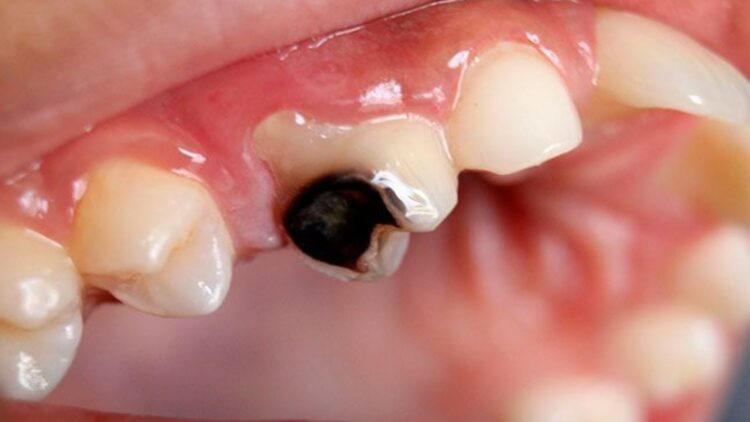
Oh, the health of our mouths. Tartar, cavities and dental plaque are some of the main health problems we all deal with. And no, we don’t like going to the dentist either, but it’s mandatory, because later we sure like eating pork chops! Now, a group of scientists has found a natural molecule that can eliminate up to 90% of the bacterial plaque that causes cavities!
If all goes well, this could be a serious shift in the way we care for our teeth, but watch out, you’ll still have to brush every time you eat—don’t be nasty! The discovery was led by a team at Ben-Gurion University of the Negev, with support from researchers in China and Singapore.
The compound is called 3,3′-Diindolylmethane, or DIM for short. It’s naturally present in some vegetables. And although everything has only been tested in the lab so far, it looks promising enough that its possible use in toothpaste and mouthwash is already being studied.
How did they find this?
They were looking for ways to stop Streptococcus mutans, which is the bacteria most associated with the appearance of cavities. This bacteria shows up after eating, when there are sugar residues and heat, and forms that sticky layer that clings to the enamel. Over time, that plaque wears down the tooth and the problems we all know start.
In the experiments, DIM was able to reduce biofilm development (bacterial plaque) by 90%, which prevented the bacteria from continuing to grow and attack the enamel. And the best part is that it has low toxicity, so it could be used safely in our everyday products.
What if they put it in toothpaste?
Professor Ariel Kushmaro, who leads the research, believes that if they manage to add it to toothpaste or mouthwash, we could have much more effective daily protection! Since it comes from plants, it would also be accessible and easy to produce.
The study was published in the journal Antibiotics and included participation from Sichuan University and the National University of Singapore.
But… it’s not approved yet
For now, all this has only been tested in the lab. There are no clinical trials in humans, and no one can guarantee the same results in real-life conditions. At the moment, DIM is not approved as an active ingredient in any commercial product against cavities. You also won’t find it in any toothpaste or mouthwash at home.
Tips for brushing your teeth and keeping a healthy smile
For brushing to be truly effective, dentists recommend brushing at least twice a day for two minutes, using a soft-bristled toothbrush and a fluoride toothpaste. It’s important to brush with short, gentle strokes, covering all surfaces: front, back and chewing areas.
Don’t forget to brush your tongue to remove bacteria and improve breath, and use dental floss or interdental brushes once a day to get rid of bits the toothbrush can’t reach. Changing your brush every three months or when the bristles are worn out is also key to keeping brushing effective. And a bit of mouthwash never hurts!
Can it change anything?
If it’s proven to work in humans in the future, we’d be looking at a very powerful tool against one of the world’s most common dental problems. A lot of people have had cavities at some point, even with decent hygiene. So if they manage to add this ingredient to everyday products, it could mean a real before and after.
In the meantime, the usual: brush well twice a day, use floss (even if it’s annoying), and don’t skip your checkups. Science is making progress, but for now, the responsibility is still ours.