
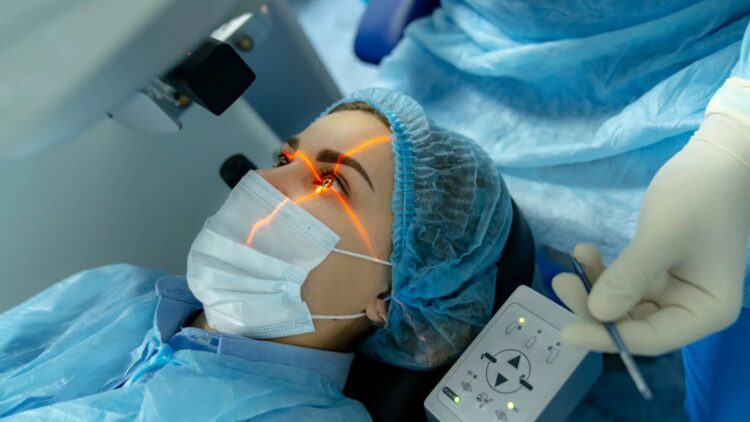
Millions of people have vision problems and many others have decided to have surgery so they don’t have to wear glasses everywhere (they surely didn’t watch Final Destination). A simple operation where you go in and out of the operating room, simple at least. But LASIK surgery has its days numbered because there is a new technique, without lasers, without cuts and in one minute.
It is called Electromechanical Remodeling (EMR) and it consists of applying a slight electric current to the cornea, accompanied by a special platinum contact lens that gives it the right shape. Instead of “sculpting” the eye, as happens with LASIK, this method reshapes the tissue in a less invasive way.
And yes, it could put an end forever to glasses and contact lenses (and careful, we love wearing glasses!).
What happens in the cornea?
As you already know, the cornea is the natural lens of your eye and its mission is to focus the incoming light so that it reaches the retina clearly. Imagine it as a window that opens the way, if the cornea has the perfect curvature, the image arrives focused and clear; but if it is too curved or too flat, the light scatters and problems like myopia, hyperopia or astigmatism appear, those sound familiar to you, right.
Why is this technique different from LASIK?
LASIK has been for years the star solution for myopia, astigmatism or hyperopia. However, its big disadvantage is that it removes corneal tissue, something that never recovers. And not all patients are candidates: those who have a cornea that is too thin are automatically excluded from the operation because it could cause irreversible damage.
EMR, on the other hand, does not destroy tissue. It makes it momentarily malleable thanks to chemical changes in the corneal collagen and adjusts it with the help of the electric current. Afterwards, the tissue regains its natural stiffness, but with the corrected shape.
How does the procedure work
A platinum contact lens is placed on the eye, the electric current is applied and in about a minute the cornea takes on that new curvature. All without cuts, without pain and with equipment simpler and cheaper than LASIK.
For now the results in tests with rabbit eyes have been a success, the road to reaching clinics will be long. First will come the tests in live animals, then clinical trials in humans and finally the approval of agencies like the FDA. It is a process that can take years, so don’t despair.
Beyond health: aesthetics and comfort
We cannot ignore that many look for these operations for aesthetic reasons. Getting rid of glasses has become a trend linked to lifestyle and comfort in some cases and as a survival method in others (have you seen what a lens of more than 10 diopters of myopia looks like?). With this technique, the dream of seeing could become a reality for many people.
This new technique, faster, safer and more accessible, may be the reason why you will never again say “where are my glasses?” when you wake up. Although it still has a long way to go, if it manages to make the leap and begin to be applied in humans, it would be the end of glasses for many!
New eye surgery technique (EMR)
| Aspect | Details |
| Name of Technique | Electromechanical Reshaping (EMR) |
| How it works | Applies light electric current with platinum lens to reshape the cornea |
| Main advantages | No laser, no incisions, done in 1 minute |
| Target conditions | Myopia, hyperopia, astigmatism |
| Compared to LASIK | Less invasive, no tissue removal, cheaper, doesn’t require corneal thickness |
| How it softens the cornea | Lowers pH with electrolysis to weaken collagen bonds temporarily |
| Testing stage | Successfully tested on rabbit eyes (ex vivo) |
| Next steps | Animal testing with live subjects → Human trials → FDA approval |
| Potential future uses | May reverse chemically-induced corneal opacity |
| Current limitations | Long approval timeline, funding still uncertain |