
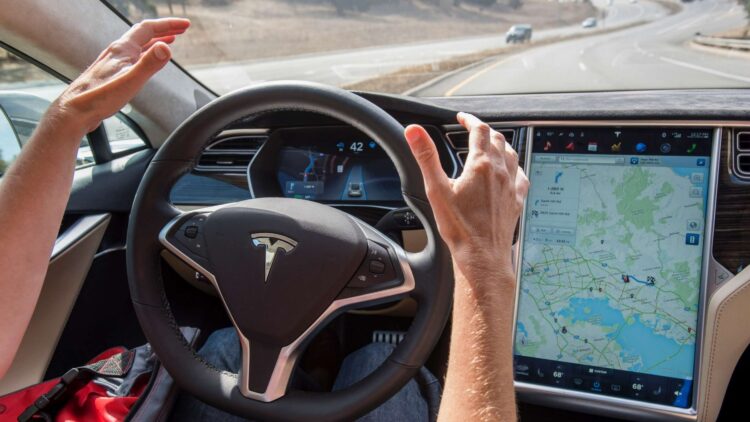
The National Highway Traffic Safety Administration (NHTSA) is going to simplify the procedures so that vehicle manufacturers can launch up to 2,500 robotaxis per year. This finally responds to the market gridlocks that have kept the sector trapped for years between recalls and silence in regulations.
The measure was announced just a few days ago and has caused a stir in the industry. Now that robotaxis are the talk of the town, with Tesla and Amazon as the main players in the series, it finally comes after years of pressure in the sector. And it arrives with a well-justified reason… Can you guess? We’ll tell you: to prevent Chinese brands from taking the lead in the autonomous driving business! Did you think it was to reduce bureaucracy? Well, that’s just a “collateral damage” of the measure.
A regulatory shift
Driving in the United States has always been a big maze of regulatory setbacks. It already happened with GM, when it submitted its application for its vehicles and ended up withdrawing it in 2020, only to resubmit it two years later… and withdraw again in 2024.
Ford followed suit, also pulling out of the race in 2023 after shutting down Argo AI. In parallel we have Tesla, which is about to launch its robotaxi service this June with Model Y vehicles adapted to current regulations.
And it has worked out great, because with the new framework, the agency will shorten review times and reduce the list of reporting requirements! China better get ready, because the U.S. auto industry is going all in!
The role of the Department of Transportation
Transportation Secretary Sean Duffy described the old system as “a tangle of paperwork that made it impossible to keep up with cutting-edge technologies,” so it’s time to change it.
With these new guidelines, the NHTSA will be able to approve or reject robotaxi exemption applications more quickly for certain safety requirements designed for traditional vehicles.
This does not mean that safety will be relaxed; on the contrary!! The goal is to adapt the regulations to the sensors, algorithms, and electrical architectures that differentiate driverless cars.
Advantages for manufacturers
- Shorter analysis times.
- Less uncertainty for multi-million dollar investments.
- Greater ability to improve autonomous driving systems in real-world tests.
Tesla, GM and Ford
Elon Musk confirmed that Tesla’s first robotaxis will keep a steering wheel and pedals, a nod to current regulations. The company will take advantage of the accelerated process to scale its fleet once it proves accident rates lower than those of human drivers.
General Motors seeks a comeback
GM faced a setback after multiple application withdrawals. But this new process will allow it to revive its plans (without waiting years for answers). Its goal is to get its vehicle on the road without controls and turn it into a key part of urban mobility in major cities.
Ford returns to the board
After shutting down Argo AI, Ford seemed to be stepping back from autonomous driving, but not at all! The company has continued developing internal software and with this change it could take advantage of the momentum to return to the field.
Risks and challenges
Although the regulatory boost is positive, there are still challenges to overcome, such as standardizing safety measures so that other drivers are also satisfied, coordinating state laws with a common regulation for all autonomous vehicles, and managing the labor transition for professional drivers. Perhaps this last point is the most complicated because it involves job losses.
The NHTSA has removed the biggest obstacle that was holding back autonomous vehicles: the uncertainty around approval timelines and criteria. Now, Tesla, GM, and Ford will be able to deploy pilot fleets and accelerate the learning curve under real conditions. The change positions the United States in the global race for smart mobility!