
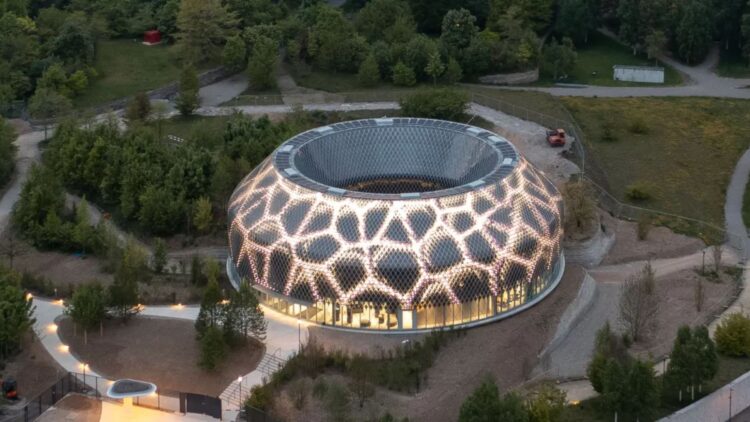
The Novartis Pavillon isn’t just another cool building—it’s one of the most exciting examples of sustainable architecture out there. Apart from its aesthetic, the striking thing about this building is how it blends the latest solar technology with stunning art and a deep commitment to protecting the planet. This shows us what the future of eco-friendly design can really look like.
This building is located in Basel, Switzerland, and it’s wrapped in 10,000 organic solar panels called OPV (Organic Photovoltaics). It doesn’t use regular solar panels, but ones made from organic materials, which are lighter and way more flexible. Due to these features, they can fit around curved and unusual shapes easily, as if it were a second skin for the building. This means the whole structure can catch sunlight in places where traditional panels just wouldn’t work. But it doesn’t stop there—the solar modules also work as a massive interactive screen, made possible by 30,000 LEDs placed both inside and outside the structure. So, let’s see what makes this building so special!
What makes the Novartis Pavillon special?
Located in Basel, Switzerland, this building is set to lead the way in architecture. It’s covered with 10,000 organic solar modules called OPV (Organic Photovoltaics). Unlike traditional solar panels, these modules are made from organic materials, making them lighter and able to fit curved or irregular surfaces better.
These solar modules are all over the surface of the Novartis Pavillon. During the day, they use the sunlight to generate electricity. What’s more, thanks to 30,000 RGBW LEDs (red, green, blue, and white) placed inside and outside the building, they also work as an interactive screen.
A building that talks through art and science
Why would a building have a screen? During the day, this screen will inform people about scientific information, health data, and messages connected to Novartis’s mission. At night, what people will see is a digital art piece, showing images, paintings, and visual works created by artists and scientists.
The art is created by Daniel Canogar in collaboration with Esther Hunziker and the Novartis scientific team. This turns the building’s façade into a special form of communication with the public, not just simple decoration.
Designed for sustainability and beauty
The Novartis Pavillon’s design was created by the AMDL CIRCLE studio, led by architect Michele De Lucchi. Later, Swiss studio iart joined the project to bring their expertise in media architecture and technology. Thanks to their collaboration, the building balances looks, functionality, and sustainability perfectly.
The Novartis Pavillon has a circular, doughnut-like shape, making it easier to install the solar modules. This combination of futuristic design, energy efficiency, and artistic content makes the building a one-of-a-kind creation.
Producing and using energy at the same time
One of the most amazing things about the Novartis Pavillon is that it produces as much energy as it consumes. Thanks to its organic solar panels, the building doesn’t rely on outside energy sources, helping reduce its environmental impact.
Finding this balance between using and producing energy is what makes the building a leading example for future green buildings.
More than just a building
The Novartis Pavillon is not only a space for activities related to health and science—it also inspires and educates everyone who visits or sees it. Its ability to generate its own energy and its “digital skin” have made a big impression. The building was even nominated for the Dezeen Awards, one of the top honors in architecture and design worldwide.
Technology is part of many things in our lives, but the way it’s used in this building is truly on another level. Designers have created a new, innovative way to use architecture, perfectly fitting the technology-driven world we live in. Have you ever seen anything like it?