
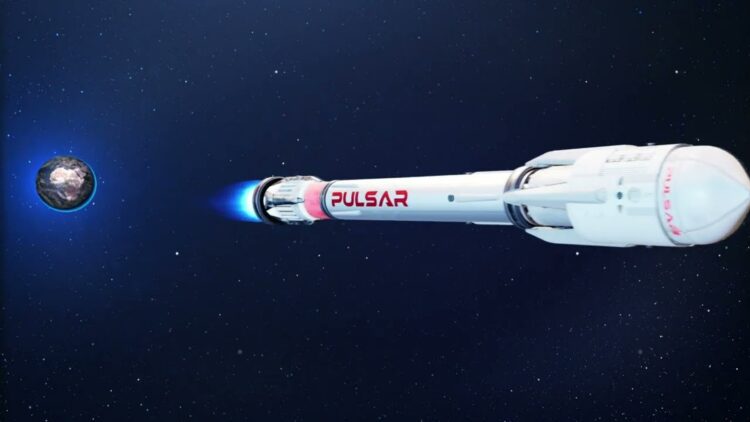
A new chapter in space revolution is about to begin with something we never would have thought of. A British company called Pulsar Fusion has presented a project that is nothing short of ambitious: a nuclear fusion rocket they have nicknamed Sunbird. This rocket is capable of reaching 800,000 km/h and, according to their calculations, it could reduce the trip to Mars by more than half the time, going from the current estimated 7–10 months to just around 4 months. We’ll tell you everything this feat involves and how it may be that we’re witnessing the future of space travel!
What is the Sunbird rocket?
The British company Pulsar Fusion, based in Bletchley (England), has been working for years on advanced propulsion systems, and this is their most recent bet: the Sunbird rocket, which is mainly based on fusion energy. What will this do? Well, create much greater thrust so that any space travel can be done in half the time.
Humans to Mars
That’s what this new technology aims for, to be the fastest object ever built and to serve for taking humans to Mars as soon as possible, and, they’re aiming even further, they want to explore Pluto or other stars.
When does it launch?
The founder of Pulsar, Richard Dinan, announced that they hope to carry out the first orbital tests of the Sunbird in 2027, because there are still some key elements that need to be put into practice. Although it may sound like science fiction, the project has a solid scientific foundation and the backing of the UK Space Agency. Everything seems to be going smoothly, or rather, on nuclear fusion!
How does nuclear fusion work?
It’s important to understand how this chemical process works in order to know how this spacecraft will function. Fusion combines atomic nuclei generating huge amounts of energy, and the best part is that it’s a clean, safe, and efficient process and will use the safest materials available, deuterium and helium-3. It is, in fact, the energy that powers the Sun, just imagine how powerful that is!
Why test it in space?
The International Atomic Energy Agency (IAEA) stated that if it could be implemented on Earth, it could provide clean, safe, and affordable unlimited energy to meet global energy demand, and that with just a few grams of those two reactants we mentioned earlier, a terajoule of energy can be generated (which is, approximately, all the energy a person in a developed country needs for about 60 years!!), but it’s much more natural to perform it in space because on Earth it would require high pressures and temperatures that are very difficult to achieve, whereas in space, the low temperatures and the vacuum make this chemical reaction easier.
Speed record
500,000 miles per hour is what the Sunbird is estimated to reach, surpassing NASA’s Parker Solar Probe, the fastest human-made object to date, potentially becoming the new fastest object in the universe. And the possibilities for research up there are endless, but they have chosen to go step by step, four months to Mars and… Four years to Pluto (which currently takes up to 10 years).
Technology is advancing by leaps and bounds, and even more so in space matters, we’re practically one step closer every day to knowing how many more secrets are hidden up there. Also, the Sunbird’s goal is to carry out interstellar flights with human life on board, and we could be talking about it being possible, in addition to being fast, to get to Mars in four months in a clean and efficient way.
Isn’t it impressive? And how much it lets us dream, maybe, colonize Mars and travel beyond our solar system… what a close and intriguing future lies ahead of us!