
Have you ever stopped to think what would happen in the world if humans didn’t exist? We’re not talking about never having existed, but rather that, by magic, biology, or some higher being, humans suddenly disappeared, leaving the cities just as we know them today. The shops, the buildings, the cars. Absolutely everything the same, but without us.
Perhaps many might think we’d be living in a technological apocalypse like in the movie I, Robot, and that the future would be dominated by humanoids replacing us in society. But we want to go further, not even these humanoids exist in this uncertain future. It’s clear that nature would make its way back into our cities, right?
Who would inherit the Earth?
It seems like we’re proposing a science fiction movie script, but it’s a scientific question that many experts have asked themselves. Curiously, from the University of Oxford, Professor Tim Coulson has dared to seek a coherent (not necessarily logical) answer to this question in his work The Universal History of Us, where he reflects on which species of animals we know today could invade our cities if humans were to completely disappear.
We promise we didn’t expect the answer either, because logic tells us that the animals that could replace us might be monkeys (because of our biological similarity) or maybe some kind of feline, being the kings of the jungle, but the answer goes much further. Coulson argues that these animals rely on social networks, and this could limit their adaptation to a world without humans.
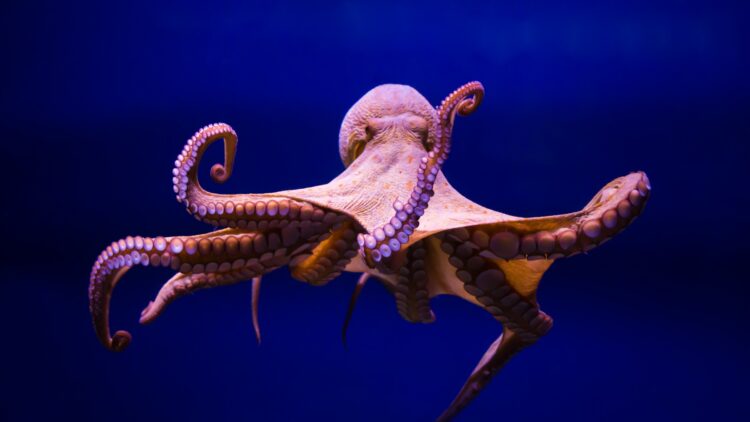
Coulson proposes something never seen before: octopuses. Yes, those eight-tentacled, suction-cupped beings that live in our oceans.
Evolution or usurpation?
This scientist reminds us that all species have an expiration date. This doesn’t mean that the human being will cease to exist tomorrow, but it is very possible that in the future, the human race will also disappear just like other species have disappeared in the evolutionary process, giving way to other species, or not.
It’s called the evolutionary process, meaning that life doesn’t stop just because someone is missing; it reorganizes, adapts, and continues (almost like life in general). And it wouldn’t be the first time Earth has experienced the disappearance of one of its dominant species (remember the dinosaurs?). Each of those extinctions has given rise to new forms of life.
Why octopuses?
This answer wasn’t chosen at random. Octopuses are fascinating animals and among the most intelligent in the animal kingdom. They have problem-solving skills, communicate by changing colour, and are experts at manipulating objects and adapting to their environment. Knowing all this, they could be ideal candidates to take the place humans would leave, if environmental changes (and a major evolutionary process) allowed it. It’s believed that octopuses could breathe outside water, explore terrestrial habitats, and interact with the environment—our environment.
From the ocean to the cities
Even if it sounds strange to us, octopuses could create their own structures and underwater cities. It wouldn’t be the first time life began in the sea and colonized the land, and we already know that history always repeats itself.
But these curious animals would also face many challenges, for example, they are animals without skeletons, and their life cycles are quite short. But who knows if, in millions of years, octopuses will have undergone mutations or unexpected events that lead to new abilities.
Why aren’t primates the heirs?
As we mentioned, it’s because they are animals that depend too much on their social environment and don’t have the radical adaptability that octopuses potentially could.
Who knows, maybe the future of our planet will return to being underwater once we are no longer populating the land.