
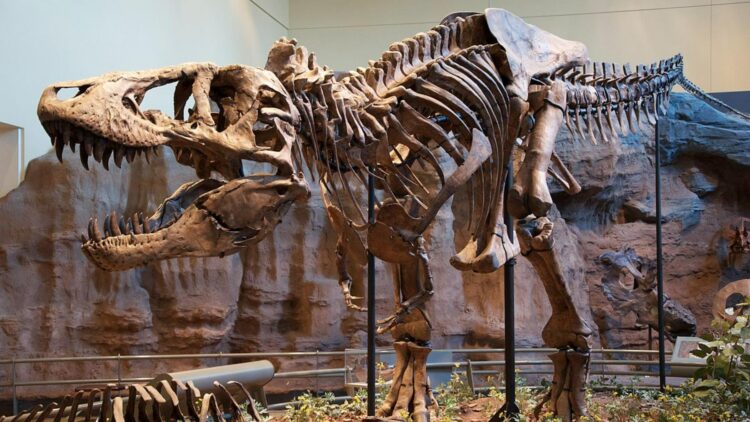
Some fossils unearthed since the 1970s and nobody had stopped to look at them closely until now, it seems incredible but they were found in the Gobi Desert (Mongolia), and now more than half a century later a team of scientists has analyzed them again. The result of the research has been a new species of dinosaur of the T-Rex type. What? Now? Yes! And they gave it a rather powerful name: Khankhuuluu mongoliensis. And yes, it sounds like a legendary creature, but it existed and it is extremely hard to pronounce.
Small but fierce!
Unlike the colossal T-Rex, this dinosaur measured about four meters long and weighed about 750 kilos. Not bad, but far from the six tons of the Tarbosaurus. The Khankhuuluu, however, had something that makes it much more special: it is the closest known relative of the T-Rex, and with the discovery of its existence the family tree of tyrannosaurs is completely rearranged.
A prehistoric journey between continents
Scientists believe that this dinosaur lived about 85 million years ago and that, at some point, it migrated from Asia to North America crossing a land bridge that connected Siberia with Alaska (the flat-earthers love this). But that migration was key for tyrannosaurs to diversify and evolve until they became the giants that dominated the Cretaceous before disappearing 66 million years ago!
“This discovery forced us to look at the tyrannosaur family tree with different eyes. There was a lot of confusion about who was related to whom, and this species has given us the missing clue to rewrite that history” paleontologist Darla Zelenitsky
50 years waiting for its moment
As we told you, the bones of this animal were discovered in 1972 and 1973, but for years they were overlooked or not well understood, or simply thought to be something already seen. And it has all been thanks to new technologies that experts have been able to confirm that it is a completely new species!
More than a discovery
That’s right, this officially confirms that the T-Rex was not born in North America, but that its roots are in Asia! In addition, all this opens the door to re-investigate all those fossils that for decades nobody paid attention to, who knows if experts might end up finding more relatives?
“This underlines the importance of Asia in the evolutionary success of tyrannosaurs” Cassius Morrison, from University College London.
And no wonder. Sometimes, to understand the present, you have to look back at the past with today’s eyes!
And now what?
This new dinosaur not only adds to the list of known species, but also reopens debates and lines of research that seemed already closed! And if there are still pieces of the puzzle to be found? Old fossils will have to be examined again, perhaps they can keep bringing surprises.
In short, the Khankhuuluu mongoliensis is not just a hard name to pronounce. It is proof that the history of dinosaurs is far from being fully written, and that even the most mythical creatures, like the T-Rex, have a past much more complex and fascinating than we imagined, roar!!