
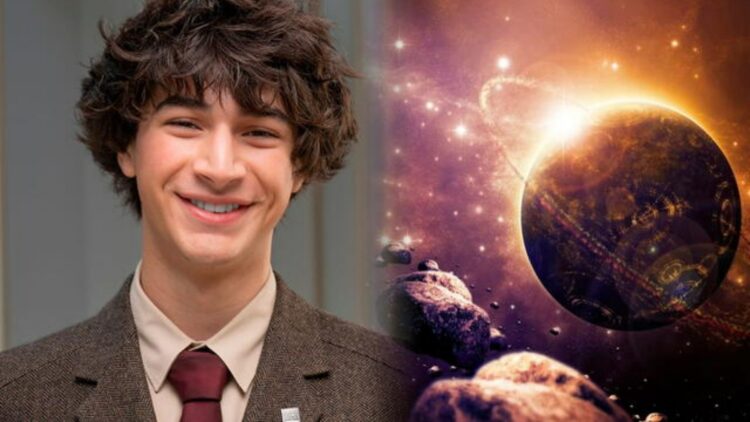
Sometimes the smartest minds are not in the most prestigious laboratories, but in the minds that are still being formed! That is what happened with Matteo Paz, maybe his name does not ring a bell. Yet.
Who is Matteo Paz
A high school student from Pasadena (California) who in a class exercise discovered how to detect 1.5 million space objects. Yes, it surprises us the same way it surprises you! Well, this young man used the archived data from a NASA telescope and achieved what had been hidden for years, so much that it ended up being published in The Astronomical Journal, and surprised the entire scientific community.
The discovery
Paz was participating in the Planet Finder Academy program at Caltech, under the supervision of astrophysicist Davy Kirkpatrick. They had as a base data from the NEOWISE telescope, launched in 2009 to look for asteroids near Earth, but which is no longer active.
Well, Paz took this opportunity to create his own machine learning model, and in less than six weeks he already had a system that detected almost invisible light variations, capable of revealing binary stars, supernovas or quasars that had gone unnoticed among billions of records! Incredible…
NEOWISE and archive
The NEOWISE telescope collected more than ten years of data in the infrared spectrum, an archive of 200 billion observations. It was material impossible to analyze without the help of very advanced algorithms, but Paz’s AI seemed to be the solution to the problem.
Signals began to appear that until then seemed invisible, his model applied mathematical tools such as Fourier transforms and wavelet analysis, which allow detecting tiny fluctuations over time.
The magnitude of the catalog
Paz’s achievement was not finding a few anomalies, we are talking about a high school student being able to create a catalog with more than 1.5 million objects that can now be studied by new generation telescopes like the James Webb!!
And the most impressive thing is not only the figure, but the infrared map that comes from this work. We are really not aware of everything we can discover from here!
From student to astronomer
Of course, Caltech’s doors opened for him. Paz was hired as a research assistant at IPAC, where he now helps improve the algorithm and train other students like him.
His skills in time series modeling, astrophysics and computational are not typical of someone his age, but he acquired them at the Math Academy of Pasadena, in the school district itself.
AI and astronomy
What this case shows is that machine learning not only accelerates discoveries, it also allows detecting patterns that go unnoticed for humans. And yes, AI is here to stay and adapting it to all fields is only a matter of time!
Of course, there are no lack of criticisms. Some experts warn that these techniques still have limitations in costs and much precision, and that they cannot completely replace the classical methods. But what was achieved by Paz, and validated in a prestigious scientific journal, makes it clear that AI is already unstoppable.
At his young age, Matteo Paz has done something incredible. With his own algorithm and a telescope retired from the labor market he managed to bring to light 1.5 million space objects never seen before.
Maybe the future of space exploration is in our computers, and in the hands of those who are still learning to write in the classroom! Or maybe we are only facing the Hawking of the 21st century.