
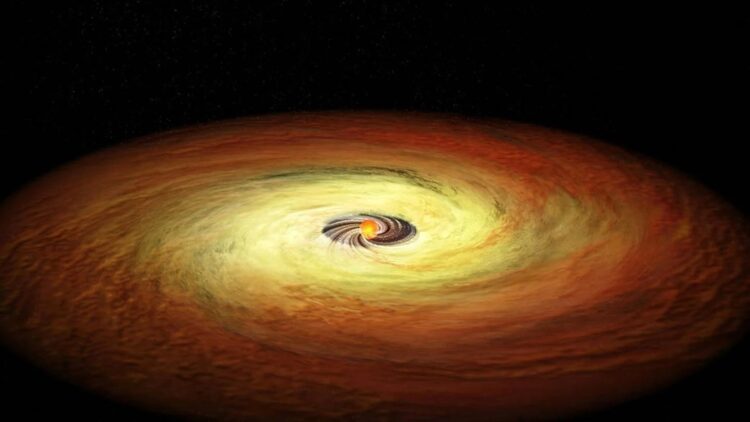
NASA found ‘’planet factory’’ that contradicts the theory of celestial bodies being formed within 10 million years. Thanks to the powerful James Webb Sàce Telescope, it was possible to see a star surrounded by a protoplanetary disk (gas and dust) of 30 million years. This disk is like an active ‘’planet factory’’ long before astronomers knew.
This is another NASA discovery that strikes scientists and changes the ideas on how and when planets are created. Is this an open window to the possibility of the formation of more celestial bodies in the universe? We’ll see.
NASA’s finding
NASA has recently found a ‘’planet factory’’ that has been active for millions of years. By using the James Webb Space Telescope (JWST), scientists could see a protoplanetary disk of 30 million years! This was a surprise for scientists because they thought these disks disappeared long before, within 10 million years. So, this discovery contradicts what it was originally believed.
We have mentioned the term protoplanetary disks, which is a very scientific one, so let’s explain it before getting into details of this new discovery.
What are these disks?
Most people don’t know what these disks are, so let’s make it clear in order to properly follow the story of NASA’s finding.
Picture a young star surrounded by a huge cloud of dust and gas, this material will join together as time passes and they will form small balls that will eventually increase their size. Once this happens, these balls will become planets, moons or asteroids.
So, these disks are useful for new celestial bodies because they act as if they were ‘’cribs’’.
30 million years protoplanetary disks
Until this discovery, scientists believed these disks only lasted for 10 million years, but it’s not. After this, the radiation from the star (the heat and energy it emits) makes the gas and dust dissolve throughout space.
However, this recently discovered disk is 30 million years old which means it still has the needed material to form planets. Now, they have more time to be formed!
The ‘’factory’’ location
It’s 267 light years from Earth, which is not very far universe wise. The star in the center of the previously mentioned disk is called J0446B and it’s a tiny star, smaller than our Sun. Despite its size, its disk is full of material to create planets, which makes scientists think there might be other tiny stars with durable disks too.
TRAPPIST-1 system
This system is just 40 light years from Earth and it has 7 planets of which three of them are in the ‘’habitable area’’ – they could have liquid water. Thanks to this discovery, scientists can understand how this system was formed because the celestial bodies in TRAPPIST-1 could have been formed slower than regular ones, similar to what’s happening in J0446B.
More similar cases
Scientists have found more planetary disks in a nearby galaxy called Small Magellanic Cloud where there are between 20 and 30 million years stars still surrounded by the material needed to form celestial bodies. What’s striking is the fact that this galaxy has few heavy elements, like the ones on Earth.
Importance of this discovery
New discoveries about the universe could lead scientists to better understand where we come from or even if there’s life on other planets. Thanks to this NASA finding, some theories, that were thought to be right, were contradicted and scientists could follow a correct theory in further studies.
So, who knows what scientists will find next? Do you think they are closer to finding an answer on life on other planets? This question is probably what people are most curious about the universe. Don’t you think so?