
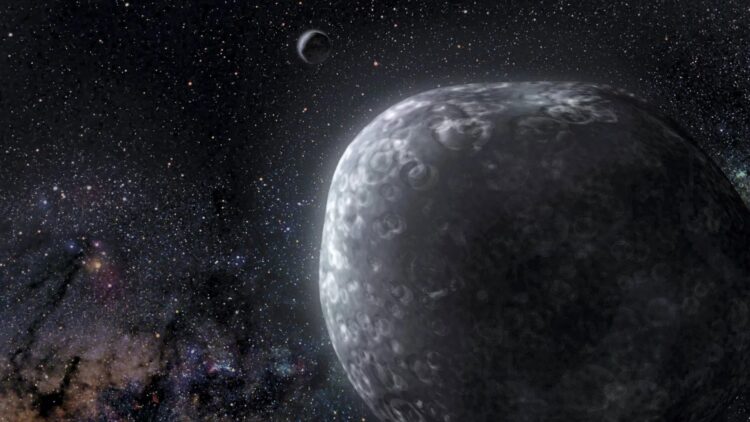
Astronomers from Princeton University say that there could exist a structure so ancient that it was already there when our Solar System began to form. Located about 43 astronomical units from the Sun, it is hidden in the Kuiper Belt. Cold, orderly, like an orbital fossil that has been watching everything around it change for billions of years.
The Kuiper Belt
It is beyond Neptune, between 30 and 50 AU from the Sun, and it is very frozen. That is also where Pluto, Makemake, Eris and thousands of small bodies are, forming part of that belt, and that now could confirm that they were there since the Solar System formed.
NASA calls it the third zone of the Solar System because, basically, it is an open-air cosmic museum. Already in 2011 a very rare group was discovered there (the famous kernel) with incredibly circular orbits.
But now, by analyzing more than 1,650 transneptunian objects with a special algorithm (DBSCAN, for the data geeks), the researchers confirmed the kernel… and found another, more internal group, colder and even more stable, and they called it the “inner nucleus.”
Their orbits are so, so circular (eccentricity 0.01–0.06) that it seems they have never undergone any kind of modification. No large collisions, no violent gravitational changes. It is as if they had been there since the first day of the universe watching the millennia pass by.
What if it is a real primordial structure?
Well, it could be. Experts are trying to find an explanation, and one of the theories is that these objects formed exactly there more than 4 billion years ago, and that nothing has touched them since then!
Others believe it is due to Neptune’s jumping migration, a gravitational dance in which Neptune moved in “jumps” through the solar system and shaped its surroundings at will. That model explained the kernel… so now it could also explain this new inner nucleus.
But of course, there are still open questions, like whether it is really a distinct group or an extension of the kernel. Or whether maybe we are interpreting too soon something that could simply be a pattern or a statistic.
The authors themselves admit that they still cannot confirm 100 percent that this structure really exists like this, but more evidence is still needed. Even so, the hype is strong among scientists!
Still, if it is proven that the inner nucleus is real, it would change everything we know so far about this process, because we would better understand how the giant planets migrated, we could reconstruct past events, and we would have a time capsule that has literally remained frozen since the origins of the Solar System.
What now?
Right now the great hope is the LSST (Legacy Survey of Space and Time) from the Vera C. Rubin Observatory in Chile, which will begin to map the sky in depth. Its work will allow the detection of much fainter and more distant objects, measure their orbits precisely, and determine whether the inner nucleus is truly a distinct structure! And if that happens, Rubin will find it. And if not, we will also know.
What would confirming it mean?
Perhaps we could then have more information about how our system was formed and be able to investigate other regions that have also remained intact since the beginning! In this chaos, who knows if there are more formations like this in space and we could learn more?
A unique opportunity
If this is confirmed, scientists could investigate what the planets were like just before everything began to change. It may not seem incredible to you, but we assure you that it is!
The past of the Solar System
A frozen fragment of the past, something that survived everything that came afterward, and that is incredible!
Now we only have to wait for the new telescopes to go into action and confirm or disprove this theory. What do you think, will it give us any clue?