
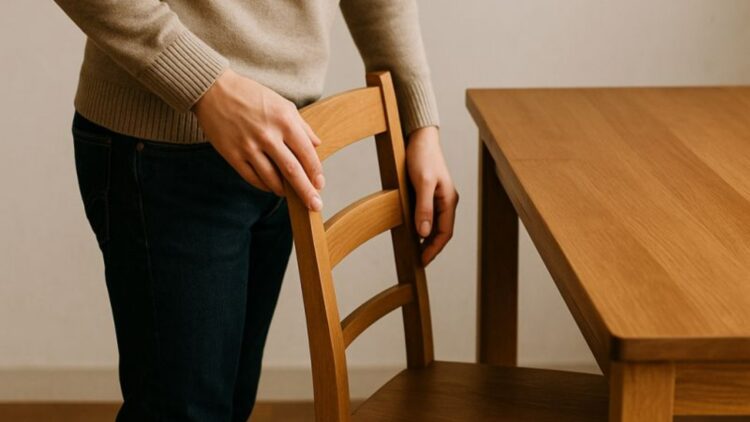
A simple and automatic gesture, standing up and pushing the chair back in. It is something we do very often, right? Well, something we have normalized hides a double meaning, not only politeness, but also how you think, how you relate to others, and what kind of person you are when no one is watching. And be careful, because most people who do this gesture are not even aware of it.
A minimal gesture
You are in a restaurant, in an office, or anywhere, and just as you stand up, you push the chair in. You pause your life for half a second before leaving. That micro moment breaks your automatic pilot of “I stand up and I leave”.
There appears a mind that has internalized the impact of its actions, something you already have integrated, and it goes beyond perfectionism, it is social awareness, and it works on its own.
Key to empathy
Psychologists call it “practical empathy”, and it is not the one that is proclaimed, it is the one that is exercised automatically.
In the act of pushing the chair, it means that you make it easier for the next person to pass, you avoid inconvenience, and you show that you are taking care of a space that you know is not only yours, that it is shared.
And all of that without needing applause.
Self control
From the outside it seems like just another act, but psychologically it is a clear example of self control. Controlling the impulse to leave without looking back requires minimal internal regulation, so people who train these kinds of small gestures usually also transfer it to other areas, work, relationships, emotional management. They are people with calm discipline who do not seek drama.
Reliable people
And showing that you are a reliable person can open many doors, for example in work meetings. This way you show that you are organized, responsible, and attentive to details.
Learning to share
Spaces belong to everyone, and this way you show that you respect them and also respect the rest of the users who will use the same space. These studies suggest that those who take care of shared spaces tend to be much more aware of and committed to the community.
Detail oriented people
A good project and an excellent project are differentiated by small details that people do not even notice, and if you think about it, it is usually linked: small details equals awareness of the environment.
Responsibility in everyday life
They are people who follow through, who respect implicit rules, and who understand that order is not something that “someone imposes”, but a personal responsibility, and these micro behaviors make them much more organized and committed people.
How you relate to what is not only yours
Pushing the chair also speaks about your relationship with shared spaces. It is not your table, it is not only your spot, and even so, you leave it ready for the next person who arrives. It is thinking about the collective good and about how you would like the rest of the world to also take you into account.
Who you are when no one is watching
And in psychology it is said that character is defined when no one is watching, that is, when there is no reward or punishment. That second of pause before leaving is a powerful skill and says a lot about you. They are not people who react, but who respond and know how to manage situations better.
So?
Pushing the chair does not turn you into Jesus Christ, but it does reveal that you have consideration, self control, responsibility, and respect, and all of that can be seen in two seconds. And the way you do small things also shows how you do big things.