
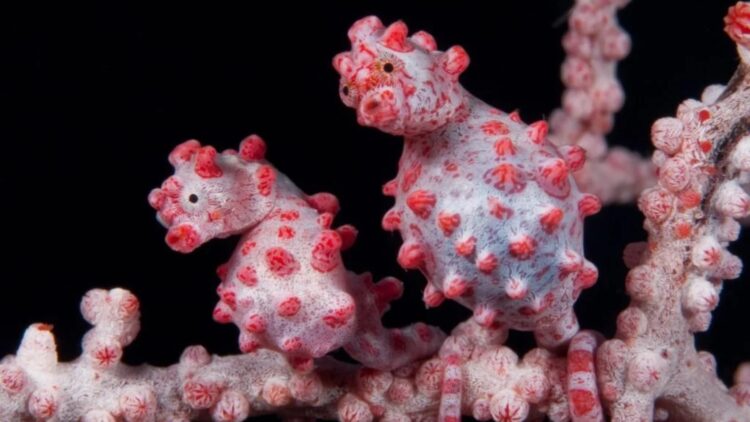
The seahorse is already one of the most fascinating creatures in the ocean, but when you read this article about the pygmy seahorse you will see it’s very special. This tiny animal became a master of camouflage not by gaining new genes, but by losing DNA. A new scientific study shows that sometimes evolution works by taking away, not adding, and the pygmy seahorse is the perfect example. So, let’s find out more about this marine creature.
What makes the pygmy seahorse special?
In case this is the first time you hear about this particular marine creature (also known as Hippocampus bargibanti), let’s talk about it a bit:
- It lives in the reefs of the western Pacific Ocean.
- It is about two centimeters long.
- It hides among corals that look like alien gardens.
- Its camouflage is so perfect that for years divers didn’t even know it was there.
- It copies the colors, shapes, and textures of the coral it clings to.
Analyzing the DNA
Scientists found something unexpected when they studied the Hippocampus bargibanti’s DNA: it had actually lost a huge number of genes compared to other seahorses (at least 438 genes are completely gone, and another 635 are damaged or don’t work anymore). This shows that the pygmy seahorse didn’t evolve by adding complexity, but by simplifying its genetic code.
Let’s talk about its nose
Most of these animals have long, tube-shaped noses, but the pygmy seahorse is different: it has a short, rounded nose. Scientists discovered this is because it lost a key gene called hoxa2b, which normally helps shape the head. Without that gene, the nose stays small, making it look more like the coral bumps where this marine creature hides.
The skin
The pygmy seahorse has bumpy skin, and this is because some of its genes are missing or don’t work the same way as in other animals. Normally, genes decide if skin will be smooth or shaped. But in the pygmy, those controls are gone, so its skin grows little bumps that look just like coral.
Scientists also found changes in “genetic switches,” which are like on/off buttons for genes. Because some of these switches are missing, the pygmy seahorse keeps certain baby-like traits—such as a small head and textured skin—for its whole life. These features help it stay perfectly disguised in its coral home.
Weak immune system
Another surprising discovery is that the pygmy seahorse has the weakest immune system of any known vertebrate, it lost many genes needed to fight disease.
Normally, this would be dangerous, but the pygmy seahorse has a secret ally: its coral home. Corals produce natural antimicrobial chemicals, which protect both the coral and the seahorse. Living permanently on the coral allows the pygmy to survive with a reduced immune system.
Male pregnancy made easier
If you ask someone about these animals, they might tell you that males carry the babies. This is one of the most popular pieces of information about this animal and it’s fascinating because usually a father’s body would reject embryos as foreign tissue. However, the weak immune system of the pygmy seahorse prevents this rejection, making male pregnancy smoother and more efficient.
Evolution by subtraction
The story of the pygmy seahorse changes the way we think about evolution: Instead of gaining new genes, it thrived by losing DNA. These genetic losses shaped its nose, skin, immune system, and unique way of reproducing.
Scientists call this “evolution by subtraction.” In this case, less really is more, the pygmy seahorse became one of nature’s best camouflage artists by simplifying its DNA.
So, for scientists, the pygmy seahorse is a reminder that nature is endlessly inventive. And for the rest of us, it’s a wonder of the ocean, proof that even the smallest creatures can teach us the biggest lessons. That’s why we should take care of the environment, so that marine life continues to exist. We can’t allow these wonders of the ocean to disappear.