
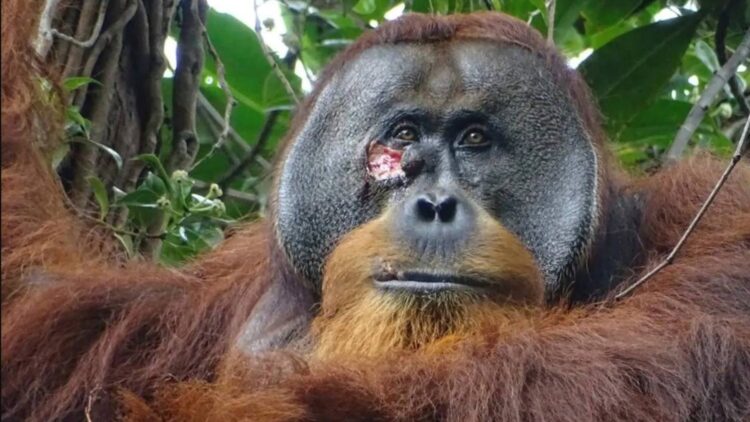
Maybe you don’t know who Rakus is, but I’m sure after reading this article you won’t forget this name. In 2022, a male orangutan, named Rakus, fought against another orangutan in the rainforests of Sumatra, Indonesia. I know, this is nothing special, but he did something that shocked scientists: Rakus was the first orangutan ever observed using a plant as medicine to treat an external wound.
This finding, published in the Scientific Reports magazine, could change what we know about the relationship between animals, humans and medicine. So, let’s find out more about Rakus.
Rakus: the wounded orangutan
Rakus is a 30 year-old male orangutan that lives in the Gunung Leuser National Park, in Indonesia. In the summer of 2022, researchers heard a strong fight between males at the tops of the trees. At first, they thought it was just a regular fight between orangutans but the important part of the story is what the orangutan did the next day, when they saw Rakus with a serious wound under his right eye and inside his mouth.
Making its own medicine
The most common thing is to wait until the wound heals by itself, but Rakus did something that scientists could believe: he started to chew leaves of a plant called liana. However, it’s curious that this plant is not part of orangutans’ regular diet, but humans know it as a natural painkiller.
Rakus was so clever because he used the green paste he created in his mouth to spread it onto his wound, as if it were a pomade. He did this several times the following days.
And this was the first time in history that scientists saw an animal apply a plant on a wound in such a clear way.
Did it work?
Yes! Rakus’ wound healed very fast, in less than a week, with no signs of infection. Experts believe the plant helped him relieve the pain and prevent complications. This behaviour showed that orangutans can identify plants with their medicine properties and use them in an effective way.
So, this means they are so intelligent
Of course they are. Orangutans share 97% of their DNA with humans and are known for their intelligence. I mean, they use tools, learn from their mothers and can recognize hundreds of plants in the forest, sometimes more than 400! What’s more, they know what fruit they can eat, when they are ripe and how to prepare them. This wisdom from the rainforest explains how Rakus could discover that liana was useful to cure himself.
Do other animals do this?
This phenomenon is called zoopharmacognosy and it suggests that maybe humans learnt about healing plants observing animals. Rakus isn’t the only animal that treat themselves because, throughout the years, researchers have observed:
- Chimpanzees eating bitter plants only when sick, probably to fight parasites.
- Orangutans in Borneo rubbing their bodies with a plant used by humans to treat joint pain.
- Even insects using natural substances to protect themselves from disease.
Importance of this finding
Rakus’ story teaches us a few important things:
- Orangutans are more intelligent than we thought, capable of solving problems and even creating medicine.
- Our human ancestors may have learned from great apes. If orangutans can discover natural remedies, perhaps early humans did the same by observing them.
- Protecting orangutans is urgent. Fewer than 14,000 Sumatran orangutans remain in the wild, and their rainforests are shrinking due to deforestation and climate change.
So, protecting these animals is more than saving a species, it’s also protecting part of our own history and a symbol of how nature hides secrets yet to be discovered.