
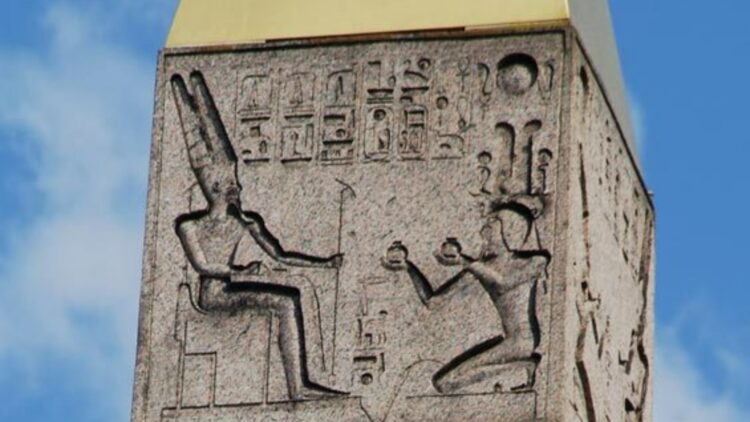
There is nothing in today’s world that generates more excitement than Ancient History. Specifically, the history of Egypt. And the truth is, Egypt still holds some of the greatest secrets of humanity, but this time it was not Egypt that was the protagonist of the discovery, but France. The Luxor Obelisk, which stands in Paris in the middle of the Place de la Concorde, has revealed things we never could have imagined. Until now, what seemed like a simple decorative relic for tourists to take pictures with has turned out to hold seven hidden messages carved thousands of years ago under the orders of Ramses II. Perhaps these secrets may not seem like a novelty, but they contain a strategy of divine propaganda intended only for the Egyptian elite.
The discovery was made by Jean-Guillaume Olette Pelletier and has shown the world that the Egyptians used their monuments to “communicate” with the divine elites. We’ll tell you everything about this discovery below.
How was this discovered?
It all began in 2020, during the COVID-19 lockdown. Olette-Pelletier, who by the way is a professor at the Paris-Sorbonne University, observed the obelisk during one of his daily walks, and since 1836, when the obelisk arrived in France as a gift from the Viceroy of Egypt, no one had paid much attention to it, until Olette Pelletier arrived, who quickly noticed symbols out of place, strange decorations, and a sequence of hieroglyphs he didn’t understand.
The Olympic Games, VIP access
In 2021, this archaeologist had privileged access to the top of the obelisk thanks to scaffolding installed for its restoration ahead of the Paris Olympic Games. It was there that he confirmed his suspicions: the monument was full of encrypted messages, designed to be read from very specific locations, such as the center of the Nile River, right in front of the original temple of Luxor. Something that, truly, gives you goosebumps.
3D hieroglyphs
The most unsettling thing is that this system discovered by Olette-Pelletier not only forms words, but also different phrases depending on the position the observer takes to read them. Wait, let us explain it better: the inscriptions can only be properly understood if you stand in the correct spot, and if we remember that this obelisk was originally placed in front of the Temple of Luxor, we are talking about the fact that these inscriptions could only be seen from its highest point.
What do the inscriptions say?
These seven inscriptions have a political context that is important to mention. Ramses II, despite being one of the best-known pharaohs and son of Seti I, came to power as an adult, thus excluding himself from “divine birth” (they believed the pharaoh had been directly begotten by a god, which made the pharaoh not only the ruler, but also the child of a deity).
Once this is explained, we can detail which images stand out the most. On the side that originally faced the Nile, Ramses II appears making an offering to Amun, the god, crowned with the pschent (a symbol of the unification of Egypt), and of course, this image was not seen by the common public, only by nobles arriving by boat during the Opet (a divine renewal event of pharaonic power). The objective? Very clear: to show that Ramses was not only a king, but also the chosen one of the gods.
Other hidden symbols
Let’s remember that there are seven cryptographic systems found. One of them, for example, shows a crown with bull horns (symbol of the ka) and an offering table forming a phrase that invites the appeasement of the god Amun, reinforcing the daily need for ritual to maintain cosmic balance.
Another of the discoveries includes the full name of Ramses II (Ousemaatre-Nebkhespesh), which reinforces his divine power.
Is the history of Egypt being rewritten?
Something like that, yes. Far from being just a tourist monument, this obelisk has been presented as a direct message to the elite of the time, and the most incredible part of the discovery is that only six Egyptologists in the world are capable of reading crypto-hieroglyphs!! How many secrets of Ancient Egypt are still left to discover?