
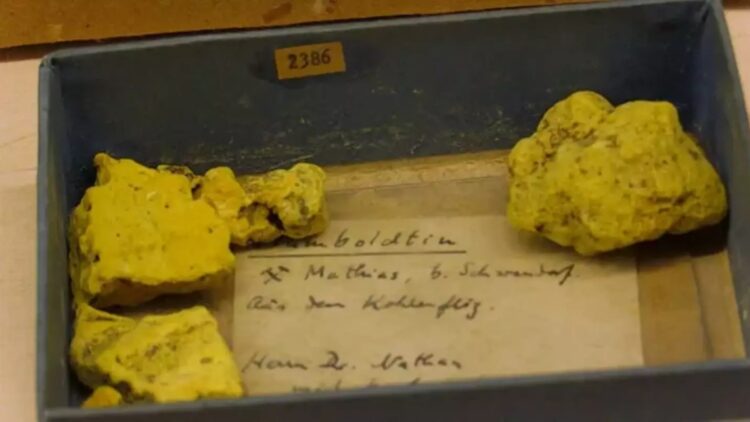
We heard about so many scientific discoveries throughout the year, but this Humboldtine discovery is way different. We tend to see modern digs in which advanced machinery or top labs analysis are involved, but this time the Humboldtine finding was something unexpected. We are talking about one of the rarest minerals on Earth that has been rediscovered thanks to a letter written back in 1949. How could this be possible? Let’s find out.
Humboldtine
This is such a rare mineral that it’s only known in 30 places around the world, among them we find: Germany, Brazil, United States, Canada, United Kingdom, Hungary, Italy and Czech Republic.
What’s remarkable about this mineral is that it doesn’t show up like those shiny crystals we tend to see in museums or jewelry shops. Most of the time, it appears as a yellowish, amorphous mass, and sometimes even in small fragments.
And if you were wondering about its name, Humboldtine was chosen the first time it was discovered back in the 19th century to honor Alexander von Humboldt. This man was a famous German naturalist and explorer who travelled around the world and was a passionate collector of minerals.
Why is it so special?
From a chemical point of view, Humboldtine is so special because it belongs to the group called organic minerals. And… is this important? Yes, this means they contain groups of carbon, oxygen and hydrogen in its crystal structure, which is very rare in the mineral field.
The forgotten letter
A letter from the past can lead to many situations: discovering an unknown family member or maybe receiving an inheritance. We can go on imagining thousands of situations, but this time it meant the rediscovering of the Humboldtine.
In 1949, the owner of a coil mine in Germany sent a letter to environmental authorities telling them he had found Humboldtine in the Matthiaszeche mine, near the town of Schwandorf. Back then, the agency asked for samples to be analyzed, but there was never evidence of what the man said. So, the letter was kept in the archives for 75 years…
How was the letter found?
In 2023, while researchers at the Bavarian Environment Agency (LfU Bayern) were digitizing old documents, they found the letter. As you can imagine, they were so curious (who wouldn’t?) that they decided to check their historic minerals collection, which contains more than 13,000 samples kept in a box and drawers in a basement.
The search was very successful because they found a small box with a yellow mineral labelled as ‘’Oxalit’’ (organic minerals in German). However, the most striking thing about this is that the label confirmed it came from the mine mentioned in the letter in 1949! So, when they analyzed those fragments, they realized they were… Humboldtine.
Sad news
Unfortunately, not everything is going to be amazing and surprising. The Matthiaszeche mine, the place where these samples were extracted, closed in 1966 and later it was flooded. So, I’m afraid this means that there’s no possibility of extracting more Humboldtine from this place.
For mineral collectors this is very hard to handle because there will be no new fragments from that location. Whatever it is now in labs and museums, is all we have…
Mysteries of Earth
As you can see, the Humboldtine story is quite a special one. But, we can learn a few things from it:
- It shows us that nature still keeps secrets.
- Old documents can help solve mysteries.
- Even a small mineral fragment can increase our knowledge on our planet.
So, if you happen to find an old letter, you’d better check it because you never know what can result from it…