
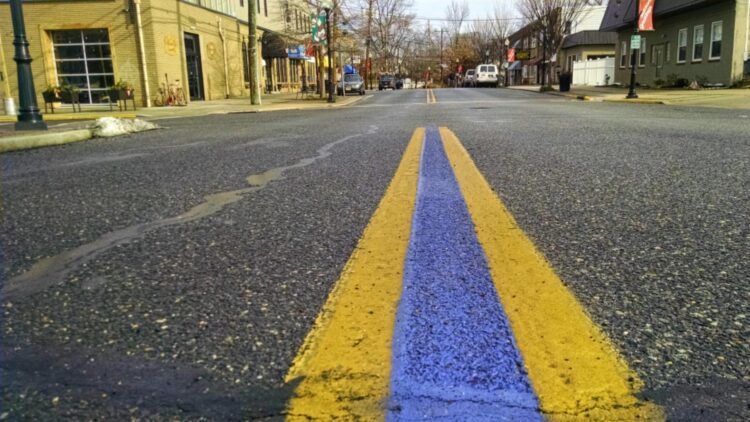
Have you noticed the blue lines on the road lately? Many drivers have been so confused when they saw them, I mean they are so used to lines in other colors. In the U.S. road markings and signals are standardized by the Federal Highway to guarantee that every signal, line, or mark is clear, safe and uniform in the entire country. This is why when drivers saw the blue lines they didn’t know if they were part of new traffic rules or what. So, let’s explain the reason behind these lines.
Road marking are so important
Lines and signals on the road are essential to drive in a safe way because they indicate drivers where to go, when to stop, and how to share the road. When someone drives from one state to another, this person needs these road markings to be the same everywhere. If this didn’t happen, drivers wouldn’t know what to do and this could lead to traffic accidents.
In the U.S., road markings have followed national patterns for more than a century. The first center line was painted in 1911, and later the Manual on Uniform Traffic Control Devices (MUTCD) was created. This manual sets the rules for all traffic signs, signals, and pavement markings. Thanks to it, white and yellow lines always mean the same thing in every state.
Most states follow these rules carefully. However, in some places, unusual colored lines have appeared. These lines were meant as symbols of support, but they surprised many drivers and raised concerns.
Blue lines in New Jersey
Normally, a double yellow line in the middle of the road divides the traffic moving in opposite directions and indicates that drivers cannot pass. The MUTCD specifies that the space between these yellow lines should remain empty, except for black paint in some special cases, like very light-colored roads.
Despite this rule, some places in New Jersey painted a blue line between the yellow ones in front of the police station to honor officers who protect the community. What a kind gesture, right? However, this doesn’t matter because that line doesn’t meet the federal standards.
After that blue line, some other places also painted more lines but in other colors. For example, red lines to honor firefighters and green ones to pay tribute to emergency medical services. Were these lines okay? No, they weren’t approved by the federal government, and they could interfere with the normal traffic flow as the blue lines.
What the Federal Highway Administration has to say
The Federal Highway Administration is in charge of keeping safety on the road in the entire country. Any change on road markings, no matter how small or insignificant it might seem, can be confusing for drivers and increase the risk of traffic accidents.
The agency explained in an official letter that there are safer ways to show appreciation for public service workers without changing the markings on the roads. They explained that adding blue lines between the yellow ones does not follow the MUTCD rules, so these lines should not be used on the roads.
The same goes for the red and green lines that were later painted. Even though these colors were meant as kind gestures, they still cannot take the place of official road markings.
So…
These blue lines on U.S. roads definitely caught people’s attention and made many drivers curious. They were a kind and creative way to show support for police officers, firefighters, and emergency workers. However, it’s important to choose ways of honoring them that do not confuse drivers. The story of the blue lines reminds us that thoughtful gestures and road safety always need to work together.