
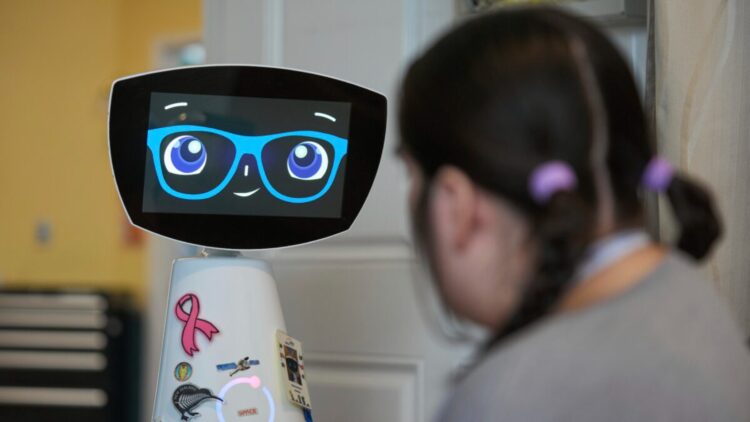
Have you heard about Robin the robot? Technology that is changing the way we work, live, and also how we care for each other when we are sick. The curious thing is that, in several hospitals and nursing homes in the U.S., a new robot called Robin has become an unexpected company for patients, doctors and nurses. So, let’s find out more about this wonderful invention.
Robin arrival
Currently, 30 health centers in 4 states (California, Massachusetts, New York and Indiana) use Robin, a robot designed to help patients to better deal with their stay at hospitals and nursing homes.
Robin is not a common robot, it was created by Expper Technologies 5 years ago as a therapeutic robot with artificial intelligence. Its appearance and voice are thought to imitate a 7-year-old girl, aiming to transmit closeness and reliability. Robin’s task is simple, but powerful: make patients disconnect from their health problems and accompany them at difficult times.
How this robot works
Robin does about 30% of its tasks autonomously thanks to artificial intelligence, whereas the 70% left is controlled by humans at distance. What’s more, clinical staff always supervise their interactions to guarantee they are safe.
Every time Robin talks or plays with a patient, it collects data and learns new behaviors. So, with each new interaction, it becomes more independent and improves its answers. According to Karen Khachikyan, CEO of Expper Technologies, the aim is that the robot gets to be more autonomous with the passage of time.
What does Robin do with the patients?
Robin’s appearance is striking because it has a rectangular body and a screen shows a face with cartoon-like expressions, which makes it look friendly and closer. Among the main functions, Robin:
- Plays with the patients.
- Plays music they like.
- Tells jokes.
- Remembers their names and greets them warmly.
The emotional impact is obvious. Samantha da Silva, expert on language at a children’s hospital in California, explained: “She brings joy to everyone. She walks down the halls, and everyone loves to chat with her and say hello.”
The future of the robot in medical care
Today, its main role is therapeutic and to accompany patients, but the plans for Robin goes beyond that. The company estimates the robot can do basic medical tasks soon like measuring vital signs and sending data to doctors and nurses.
In the long term, the goal is that this robot could also help older patients with daily activities like changing their clothes or going to the bathroom.
Lack of medical staff
Robin becomes crucial in a context in which the health system faces great pressure. The Association of American Medical Colleges projects a shortage of 86,000 physicians in the United States over the next 11 years.
Doctors and nurses are already overwhelmed with workload and, most of the time, they don’t have enough time to spend with each patient and give them the emotional attention they need. Here’s where a robot like Robin is so valuable: it can offer company, conversation, and distraction; giving more time to the staff so that they can focus on clinical aspects that are more urgent.
An unexpected partner
The arrival of Robin proves that technology is more than cold and automatized tasks, this therapeutic robot shows that artificial intelligence can be also used to care for other aspects of human’s health: company, connection, and emotional wellbeing.
Even though there’s still a long way to go for Robin to do more advanced medical tasks, this robot is already a milestone. Its games, songs, and jokes make the stay of patients at hospitals less tough, mostly for children and elderly people who are the most suffering from loneliness. Do you think more robots like Robin should be in hospitals?