
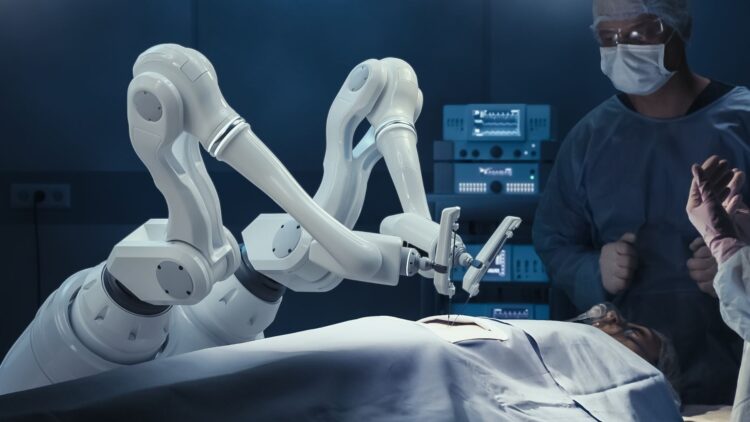
Would you trust a robot to do what only skilled surgeons used to do? At Johns Hopkins University, researchers have taken a giant leap in robotic surgery by creating a system that can carry out autonomous surgery with the help of artificial intelligence and machine learning—the same kind of technology that powers tools like ChatGPT.
In a groundbreaking study published in Science Robotics, led by Axel Krieger, a robot successfully removed a gallbladder on its own with 100% accuracy. Even more impressive? It could follow voice commands, react to unexpected changes, and learn from its actions—just like a human trainee.
There are already robotic features that are very similar to us, but what does this new machine mean for the future of medicine? Let’s find out more about this.
A robot performs gallbladder surgery
A group of scientists in the United States, at Johns Hopkins University, has done something we thought only could happen in science-fiction movies: a robot was able to perform surgery on its own, without being directly controlled by a human, and it did it with 100% accuracy.
The surgery it performed was to remove a gallbladder, which is a small part of the body that sometimes becomes inflamed and needs to be removed. It’s a common operation, but it’s not easy at all.
How did it do it?
This machine is not like normal robots that only do what they are told step by step. This one learned by watching real surgery videos. It’s like if you learned to cook by watching YouTube videos.
After watching many operations, the robot was trained to do everything by itself. Also, it was tested on an artificial patient (not a real person, but a model that looks very much like a human body), and it performed like an expert surgeon.
What did the it have to do?
During the operation, the machine completed 17 different tasks, in total. And even though the team changed some things, like the color of the organs by using a special dye, the robot adapted without getting confused. Some of those tasks were:
- Recognize important parts of the body, like arteries and ducts.
- Used surgical forceps and scissors with a lot of precision.
- Placed clips in specific places.
- Cut exactly where it was supposed to.
It also understands human voice
Another impressive thing is that the robot can listen to and follow voice commands, as if it were working with a human doctor. For example: “Grab the head of the gallbladder.” or “move the left arm a bit to the left.’’ This makes it seem more like a beginner surgeon being guided, but the cool thing is that it also learns from what it is told and improves over time.
What’s special about this machine?
The scientists explain that this robot doesn’t just execute tasks, it understands the entire process of a surgery. That’s something robots couldn’t do before. It also uses a very advanced type of artificial intelligence, similar to what ChatGPT uses, to think and make decisions while operating. It can even correct itself if something doesn’t go as expected.
A scientist said that using this robot is like teaching it to drive on real streets, with rain, traffic, and surprises… not just on a perfect and empty road.
Is this the first time it’s been done?
Not exactly. In 2022, another robot performed surgery on a pig, but in that case the environment was very controlled: the tissue was specially marked, everything was planned, and the robot only followed a pre-designed route.
This time it was different, because the new robot was able to react to unexpected changes, like a real surgeon would.
Was it faster than a human?
No. In fact, it took more time than a human surgeon, but the important thing is that it did the job just as well. And over time, it will probably get faster.
What’s next?
What comes next is to test this machine in more types of surgeries and in different situations, to see if it always works just as well. But it has not yet been tested on real people.
A doctor in the United Kingdom said that these advances are very exciting, but that the most important thing is to check if it can be used safely in humans, without putting patients at risk. Can you imagine having a surgery done by a robot? That must be crazy!