
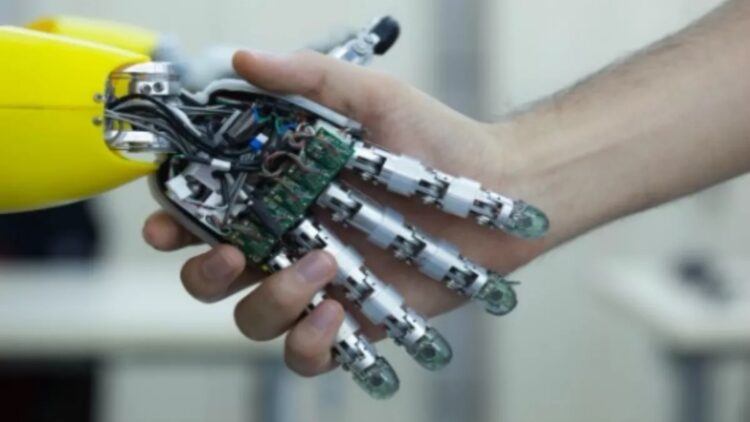
Can you imagine a robotic skin that can feel the same as human skin? Stop trying to imagine it because it’s become a reality thanks to what a group of scientists in the U.K. have done. They have come up with a robotic skin that can ‘’feel’’ different sensations such as cuts, heat, pressure and a prick. This already sounds unbelievable, but what if I told you this robotic skin could have the same level of sensitivity as human skin?
We may have heard about robots being at home with us doing the housework, but capable of feeling heat or cuts like we do? LThat’s a whole new level,. So, let’s learn more about it!
The robotic skin
The robotic skin can feel many sensations like we do, but how is this possible? Scientists only used one type of material: a thin and soft layer of hydrogel. This is like a jelly but it can conduct electricity and that’s why this robotic skin can ‘’feel’’ what it touches.
What’s normal is that robots have many sensors to detect things, one for pressure, another for temperature and so on, but this skin can do all of that with just one layer with no need for so many sensors. So, this is a huge advance for the robotics field.
How did scientists achieve this?
To make this special skin, scientists used hydrogel which is moldable, elastic, conductive, and it can be fixed on its own. They did some testing such as cutting it with sharp objects, heating it up, hitting it with hard objects, and squeezing it with metallic objects.
It wasn’t about hurting it, it was about checking if this robotic skin was able to realize what was happening. It was a success because the skin could identify all the different types of sensations.
How does the skin know?
What scientists used was electrodes around the skin, for example in the wrist of a hand made of hydrogel. There was no need for sensors inside each finger because every time someone touched the robotic skin, the electric field inside the hydrogel changed. So, depending on the sensation, the electricity behaved in a different way:
- If someone cut it, electricity almost stopped passing.
- If someone put a metallic object, electricity passed faster.
- If there was pressure or heat, it was also noticed in electricity.
Artificial Intelligence (AI) had a role in this process, because it was the one measuring and analyzing these behaviours. It was able to understand each change and what was happening in real time.
What about climate?
This robotic skin can also feel what it can’t be touched, like the environment surrounding it. It is able to detect the temperature of a place and the humidity of the air. So, this skin can feel what happens to it and its surroundings.
Usefulness for the future
As you can see, this skin can do many things when it comes to sensations, so it could be used in many types of robots such as:
- Smart prosthesis, allowing people to feel through an artificial hand.
- Assistant doctors capable of carefully touching patients.
- Robotic arms in surgeries with so much control and sensitivity.
- Autonomous vehicles, able to ‘’feel’’ better the environment.
These are just a few examples of what this robotic skin can be used for, but there are other fields it can be used to help at human jobs.
Issues with this technology
It’s true we said this is an advanced technology, and it is. However, there’s always something negative about new products. In this case, there are two aspects that should be improved:
- Hydrogel can change if it is somewhere with too much humidity or heat.
- The connection between the skin and the robot is not perfect yet. With the passage of time, cables or materials can break because of the constant usage.
Even though there are still some aspects to think about, this robotic skin means a change when designing robots. Now, it’s possible to manufacture without using so many sensors and hard materials. So, we are closer to having robots similar to us, even in sensitivity. Do you think this is a great idea?