
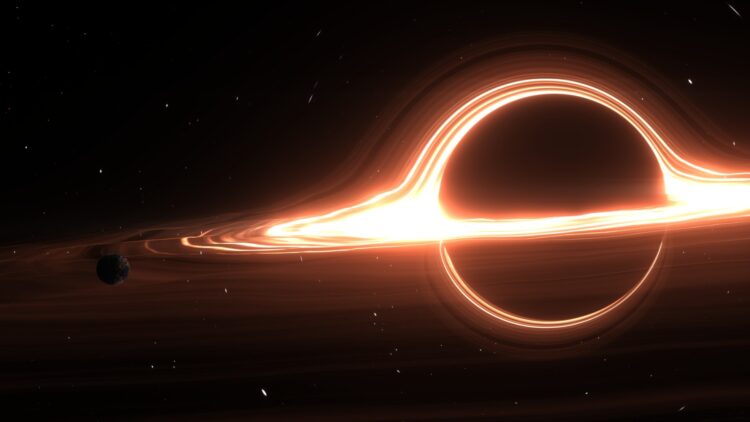
Our universe never ceases to surprise us, it doesn’t even take a day off from its own affairs! And as we already know, it is in constant motion, and our astronomers don’t stop for a minute observing what is happening in the Milky Way. All thanks to the James Webb, the trendy space telescope. Now, it has detected that there is a super black hole, but it is not close at all, don’t worry, it is 26,000 light years away from Earth and is known as Sagittarius A*. What is happening to it? It emits flares as if they were fireworks on the 4th of July. Why does this phenomenon occur? The scientific community, of course, has been flabbergasted by this discovery, because until now they believed that this black hole was relatively calm (as calm as a black hole can be, of course) but the constant activity and those flares have made it clear to them that it is not very calm either.
What have they discovered?
Until now, it was believed that black holes were “sleeping giants”, but, far from reality, the James Webb has revealed that Sagittarius A* seems to be celebrating, and the best thing is that these flares and flashes do not only last a few seconds, others last much longer, so this festival of lights varies in duration and intensity.
Where do these flares come from?
Apparently, these flares come from within the accretion disk, a structure of dust and gas that orbits around the black hole before being absorbed by its powerful gravity. But, the most curious thing is that these emissions seem to occur without a predictable pattern, which has led scientists to wonder what exactly causes them.
Why is this discovery important?
Because Sagittarius A* is not just any black hole, it has a mass of 4.1 million times that of the Sun, it is the gravitational heart of the Milky Way, and its influence extends to stars, gas clouds and galactic structures, shaping the cosmic environment that surrounds it.
In addition, the scientific world is especially eager to understand (finally) how black holes work with their environment, and how they influence the evolution of galaxies (and above all, where do things go once they are swallowed?).
This black hole is one of the few that can be observed “closely”, and allows us to learn a little more about this phenomenon that generates so much expectation.
Sagittarius A*: a very dynamic black hole
The astrophysicist Farhad Yusef-Zadeh, co-author of the study and professor at Northwestern University, has stated that the results have been surprising because it is always full of activity and never seems to reach a stable state. Yusef-Zadeh confessed that they have been observing this black hole at length since 2023 and each time they have found something different, it seems as if it were not the same astronomical entity!
And the fact is that this dynamism is not normal and has led to uninterrupted observations 24 hours a day with the James Webb telescope in order to capture more details about its behaviour.
But… what causes these mysterious flares?
No one has a definitive answer yet, but there are several theories about it:
- The short flashes are believed to be due to disturbances within the accretion disk, small bursts of energy caused by changes in the magnetic field.
- The long flares: It is believed that they could be the result of magnetic reconnection events, in which the magnetic fields within the accretion disk are violently reorganized, releasing enormous amounts of energy.
Wow, the environment of this black hole is as chaotic as it is, and there are still many mysteries to be solved
This study has opened the floodgates on current knowledge of our system, so now all that’s left for our astronomers to do is drink a lot of coffee and keep an eye on what’s happening in Sagittarius A*. There are so many things still to be discovered about our system and what a joy to be able to experience these discoveries. What’s next?