
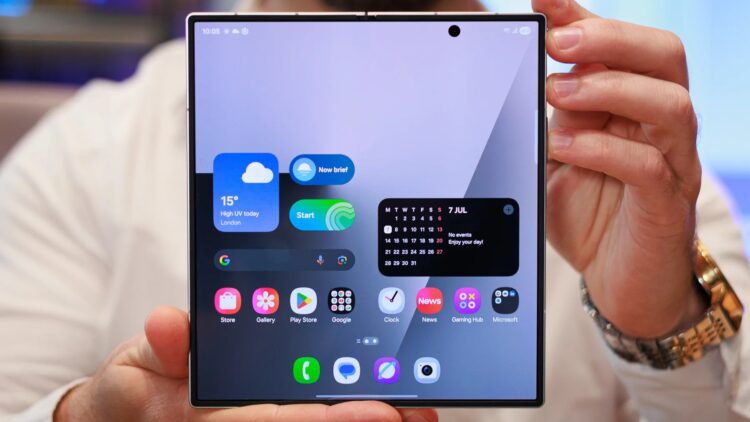
Samsung is coming up with something new in the foldable smartphone world. We have seen foldable smartphones on the market for a few years now, but recently it’s when they caught most people’s attention. They were striking devices, but very expensive, heavy and with fragile screens so people weren’t very convinced about buying them. However, the latest Samsung advances and the increasing sales in the entire world prove the story is changing. So, let’s find out more about what Samsung has to offer us.
The origin of foldable smartphones
In 2019, Samsung launched the first Galaxy Fold, a smartphone that could be opened like a book and revealed an inner screen of 7.3 inches. These devices were innovative at the time, but very thick (15.5mm), heavy (276 gr) and drained battery quickly.
That same year, Motorola relaunched its iconic Razr line with a foldable model that opened to transform into a conventional smartphone. Samsung also continued with this format with the Galaxy Flip.
The problem was that, even though they were very striking, these devices were expensive, the screens wore out very fast, and sales stalled at about 1.5% of the smartphone market.
Something changed in 2025
In the last months, the situation improved. According to the Counterpoint firm, foldable shipments experienced a 45% year-over-year growth with Huawei leading the market and Motorola lowering the prices with the Razr 60 (available from $699).
When it comes to Samsung, it reached record figures with its new recent models: Galaxy Z Fold7 and Flip7.
Galaxy Z Fold7
After testing it for weeks, it’s clear that the Galaxy Z Fold7 represents how technology has improved in comparison to previous versions:
- It’s thinner and lighter: now it measures just 8.9 mm when closed and weighs 215 gr. This makes it only 0.7 thicker than the Galaxy S25 Ultra and 3gr lighter.
- 8-inch inner screen: it’s bright, colorful, and sharp enough, despite its resolution QXGA+ of 2184 x 1968. It allows you to enjoy games, read long emails, or browse websites comfortably.
- External screen: at the front, it works like a regular smartphone, but it’s quite narrow compared to the big screen.
The way users can use this smartphone is different from others: typing with two thumbs is more precise, reading books or long emails is more comfortable, and watching images or websites is nicer. Even for simple tasks, like looking for a quote on a recording, the big screen eases the work a lot.
Problems to solve
Of course, not everything goes smoothly and the Galaxy Z Fold7 is not perfect:
- Face recognition doesn’t work well.
- The fingerprint sensor is awkwardly placed, making it feel like the phone might slip.
- The speaker sounds tinny, and the USB-C port is oddly hard to locate.
- The rear camera bump means the phone never lies flat, which is more noticeable given its large unfolded size.
What’s more, not all apps make the most of the big screen like Amazon Prime Video, which plays its content in the middle, whereas Netflix does it at the bottom half, which wastes space. Some apps even need to restart when switching between the small and large screens, disrupting the experience.
Why developers matter
Despite these details, the Galaxy Z Fold7 is a great smartphone since it’s one of the few recent devices that really offer something different beyond ‘’being faster’’. The challenge now is for app developers: if they adapt apps to foldable screens, users could make the most of the advantages of these smartphones.
Price and the future
The Samsung Z Fold7 is not cheap, its initial price is $1,999 and with this amount you can buy: a Galaxy S24 ($699), a tablet Galaxy Tab S10 FE ($430), and a laptop Galaxy Book 5 ($799). And you would still have money left.
However, the increasing sales of foldable smartphones and the tendency of lowering the prices indicate this category has a future. If apps start making the most of these screens, foldable smartphones could become a more attractive option. What do you think about Samsung’s foldable smartphones?