
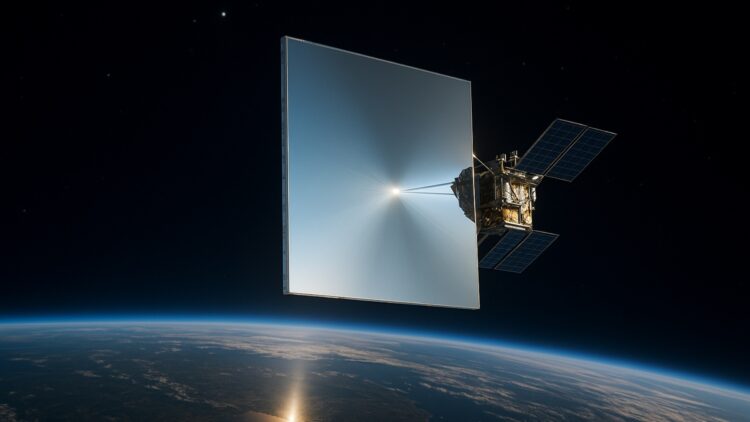
A company called Reflect Orbital has an ambitious idea: to send thousands of satellites to shine sunlight on Earth, but scientists are worried about it. The goal of the company is to help solar plants to produce electricity even when the Sun is not out. For sure, this might sound incredible, but scientists and astronomers around the world are worried about the consequences. So, let’s find out what astronomers and scientists mean by the satellites being a nightmare.
Satellites
The idea might seem simple in theory, but satellites will have giant mirrors that would reflect the sunlight towards specific areas on Earth. This would allow solar plants to generate energy even at night.
The first step is to launch a small prototype satellite called Earendil-1, which is 18 m wide, in 2026. If everything goes as planned, the company wants to expand to a full constellation of 4,000 satellites by 2030. Each of these satellites would have a 54-meter-wide mirror and orbit 625 kilometers above Earth. Experts estimate it could be required up to 250,000 satellites to reflect enough sunlight toward different locations at the same time.
The company already tested the idea by using hot air balloons with mirrors. In a laboratory test, a 2.5-meter mirror 242 meters above the ground reflected 516 watts per square meter to solar panels below. This is about half the strength of sunlight at noon, showing that the idea could work on a small scale.
Why astronomers are worried
Even though satellites that reflect the sunlight sound exciting, astronomers call it a nightmare because of the result: light pollution. Let’s see how they can lead to this light pollution:
- Unlike normal satellites, which sometimes reflect sunlight accidentally, Reflect Orbital’s mirrors are designed to be extremely bright.
- They could look almost as bright as the Sun through telescopes.
- As the satellites move across the sky, they would create flashes brighter than the full Moon, interfering with: stargazing for scientists and amateur astronomers, photography from telescopes, wildlife that is active at night, and human sleep cycles and natural circadian rhythms.
This means the sky at night could be ruined and many telescopes on Earth could stop capturing stars and galaxies in a clear way. The satellites would be particularly visible at dusk, right when most astronomical observations are done.
Technical issues about the project
There are several technical challenges about this project, like:
- Short time per pass: Each satellite can only shine sunlight over a specific area for about 3.5 minutes.
- Beams spread out: The reflected light would cover areas about 7 kilometers wide, reducing the intensity.
- Thousands of satellites required: To deliver even 20% of normal sunlight, around 3,000 satellites would be needed.
- Limited power: A 54-meter mirror would be 15,000 times dimmer than noon sunlight, meaning it produces very little energy.
The balloon tests work at the lab, but they can’ scale well to space. To have the same energy, each satellite would need 42 square km mirrors, which is something impossible nowadays.
What about economic concerns?
Even if satellites worked, the project would be very expensive because the amount of light reflected would be limited; but the light pollution would be a lot. Astronomers warn this project could ruin the sky at night and make astronomy from Earth almost impossible.
So, as you can see, not every ambitious idea is a great idea since we need to take into account different factors and the possible challenges. Now that you know a bit about this project, do you think it would be an advantage for us to use these satellites or not?