
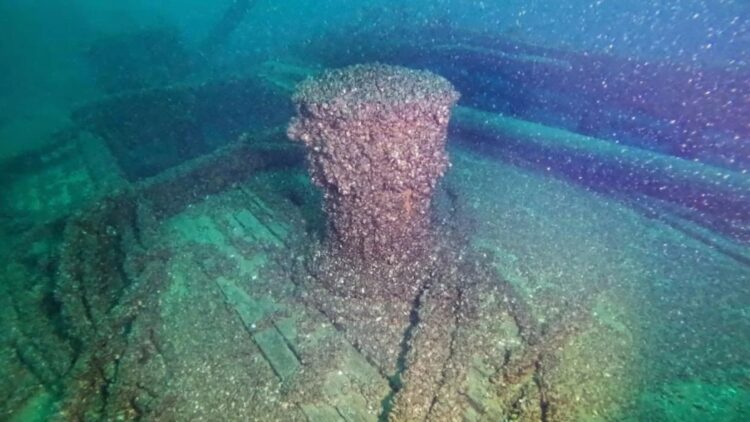
For more than a century, the schooner F.J. King was a mystery. This three-masted sailing ship sank in Lake Michigan in 1886, and no one could locate its exact resting place. Its story became almost a legend, talked about by sailors, historians, and adventurers like a ‘’ghost schooner’’. Today, thanks to the combination of technology and local memory, the F.J. King has been finally found, almost 140 years after its sinking! So, let’s learn more about this discovery.
F.J. King’s last journey
The F.J. King was a schooner built in 1867 in Ohio, and designed to transport goods through the Great Lakes. One night in September of 1886, it sailed from Escanaba (Michigan) with a load of iron bound for Chicago. Even though the schooner had sailed those waters for almost 20 years, that journey was different.
Near the Door Peninsula, in Wisconsin, the schooner faced huge waves and hurricane-force wind and water started to leak into the ship. Despite the crew’s best efforts to keep the vessel afloat, the captain ordered everyone to abandon the schooner. The crew was rescued by another ship called La Petite, but the schooner itself sank quickly, disappearing into the deep waters of Lake Michigan.
Witnesses stated that, during the next few days, they saw remains floating and even the ship’s masts sticking briefly out of the water. After that, the location of the wreck became a mystery…
Decades of failing searches
The F.J. King’s story shocked ship hunters for generations, since the 70s people tried to find the schooner using old maps and modern underwater technology. However:
- The lake is vast, and its waters are often rough and murky.
- Old accounts and coordinates were vague and sometimes contradictory.
- Fishermen occasionally reported finding parts of the ship in their nets, but these claims were never confirmed.
Even some rewards were offered to those who found it, but nobody could. This is why the F.J.King became almost mystic and known as the ghost schooner of the Great Lakes.
The forgotten lighthouse keeper
The discovery was possible thanks to an old report that had been underestimated for decades. William Sanderson, a lighthouse keeper from the Cana Island, reported a few days after the sinking that he could see the F.J. King’s masts from his tower. He sent a crew to remove them because they were dangerous for the crewship.
Modern researchers thought the lighthouse keeper’s vision could have been more precise than the captain’s during the strom. So, they decided to look for the area reported by Sanderson.
How the ghost schooner was found
The team used sonar equipment to scan the deepness of the lake in a small area of 5.2 square km. There, they found a clear artificial shape by using ROVs (small remotely operated underwater vehicles) so that they could confirm what everyone was waiting for: it was the F.J. King schooner.
Surprisingly, the schooner was almost perfectly conserved after almost 140 years and what they found 140 m deep was that:
- The schooner’s structure was preserved,
- Details like the steering wheel and hatches could still be seen.
- It looked like a time capsule resting on the lake floor, preserving a moment from the era when schooners were vital for trade across the Midwest.
Importance of the discovery
This finding is one of the most important in recent times in the Michigan Lake because it shows:
- The incredible durability of schooners built in the 19th century.
- The rich history of trade and shipping in the Great Lakes.
- The power of nature and how even experienced sailors could be challenged by storms.
- How careful research and historical documents can solve mysteries that technology alone cannot.
What’s next for the F.J. King?
The plan is not to take the schooner out of the water because that could damage it, but they are:
- Creating a 3D model of the wreck using photogrammetry.
- Working to list the F.J. King on the National Register of Historic Places.
So, this approach protects the schooner while allowing researchers and the public to study and explore it virtually. Isn’t it incredible?