
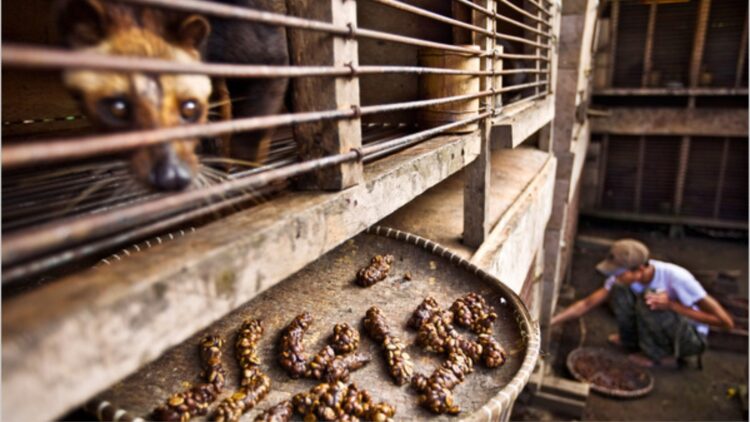
What we are going to tell you might sound crazy, but science has confirmed the most expensive coffee in the world comes from the poop of a small animal!! This animal is called the Asian palm civet (scientific name Paradoxurus hermaphroditus) and it lives in the south of Asia.
This special coffee is known as civet coffee or kopi luwak, and it can cost… more than $1,000 per kg. For years, coffee lovers have discussed what makes it so different, but now, scientists from the Central University of Kerala (India) have studied its chemical composition and they found the answer… Their research shows that the science behind civet coffee is linked to what happens inside the civet’s body when it eats coffee cherries and passes the beans through its digestive system. So, let’s learn more about this peculiar coffee, shall we?
Civet coffee
To better understand the science behind this strange coffee, we should first learn a bit about the Asian palm civet. Apart from living in Asia, we should say that it’s a wild mammal that looks like a mix of a cat and a raccoon. In its natural habitat, this animal eats the red fruits of the coffee plant called coffee cherries and inside those cherries it’s the coffee bean. Then, the civet digests the outer fruit but not the seed itself, which goes through its digestive system and when it poops we can find it there.
After that, people collect those beans, clean them very carefully, dry them, and roast them to make coffee.More than hundred years ago, someone discovered that these beans produced a softer drink with a nicer flavor than regular coffee. Since then, the kopi luwak has become one of the most expensive coffees worldwide.
Science behind its special flavor
For years, there was the idea going around that the bean’s chemical composition changed when going through the civet’s body and, to prove this, India researchers analyzed two types of beans collected in 5 coffee farms that grow Robusta coffee:
- Normal beans picked directly from coffee plants.
- Civet beans found in the poop of wild civets living on those farms.
The science experiment showed a few interesting things like:
- The civet beans were larger and had more fat than the regular beans.
- The amount of protein and caffeine was the same in both types.
- The chemical makeup of the civet beans was different: they contained higher levels of caprylic acid and capric acid methyl esters — substances that help create a creamy texture and a milk-like smell.
According to researchers this happens because of a natural fermentation process inside the civet’s stomach. As the beans travel through the animal’s digestive system, enzymes and bacteria break down certain compounds, changing their flavor and aroma.
Animal welfare
At the beginning, people collected the beans from the wild civets’ droppings, with the higher demand many producers started to close civets in cages with no natural diet, nor the ability to behave normally. Several investigations have shown that civets suffer from stress and diseases in these farms.
Even though science can explain why civet coffee has a unique taste, it also reveals the problems behind its production.
Can science help make it more ethical?
The study from zoologist Palatty Allesh Sinu and his team could help science find more ethical ways to produce coffee with a similar flavor. When researchers understood the chemical changes happening inside the civets’ bodies, they could recreate the same process in the labs without hurting any animal.
Scientists also suggest future investigations should look more closely at the aroma compounds in civet coffee and find ways to test whether a product is real or fake. This would protect customers and promote a more sustainable and responsible industry.
So, civet coffee proves that science is everywhere, even in the most unexpected places. What started as a natural curiosity has become a topic of study that combines chemistry, biology, and ethics.