
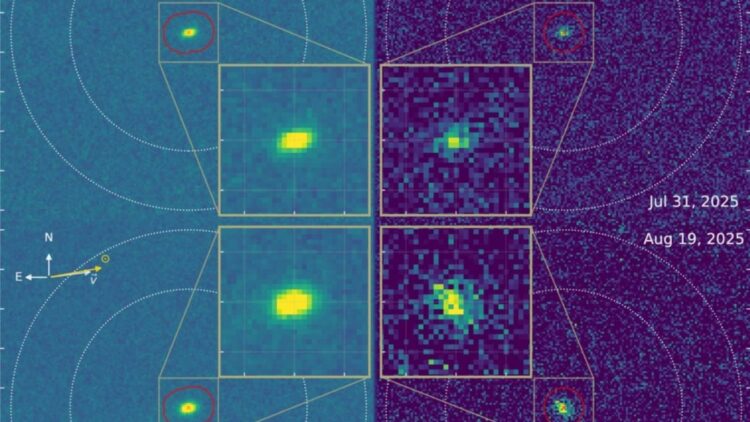
If you thought the news about 3I/ATLAS was over, wait a moment, because even though it passed quickly and rapidly through our system, it has left a lot to talk about in the scientific world. The third largest interstellar object ever detected had water in its composition. Water formed around another star, wow. Could it be that beyond our Sun there is life?
A visitor
3I/ATLAS does not belong to our solar system. It simply crossed our Solar System, most likely by chance. It must have traveled for millions of years. Also, nothing about this space rock matches anything we have seen in our system, not its trajectory, not its composition, not its speed.
And it is not the only one. Its “siblings” (they are not real siblings, obviously), ‘Oumuamua and Borisov, were similar, but none of them resemble each other. Each one brings a different chemical story, but all of them quite special. The universe is as peculiar as it is uniform, creative, diverse, and unpredictable.
Ready for observation
Imagine being an astronomer and coming across such a rock floating through our system at extreme speeds. The hype is huge. Also, think about it, this is material formed around another star, in another system, something incredible that does not happen every day or even every century.
But does it have water?
Thanks to ultraviolet observations, hydroxyl (OH) has been detected, a molecule that appears when solar radiation breaks water apart, and it is obviously the strongest clue we have found of water beyond our planet.
Water where it should not be
The comet was almost three times farther from the Sun than Earth, a distance at which ice should remain completely solid, but the data indicate that it was releasing about 40 kilograms of water per second.
Something uncommon, even for comets
Scientists believe that the water was not coming directly from the nucleus, but from small grains of ice that were breaking off, floating, and heating just enough to vaporize. A very rare behavior that has barely been seen even within our own solar system.
Planetary science, go
Until now, comparing interstellar comets with our own was complicated mainly because there were no references. Now there are. Water is the standard used to measure comet activity, so 3I/ATLAS can now be analyzed with the same tools as comets in our solar system.
Other worlds
Each interstellar visitor observed has told a different story. ‘Oumuamua seemed dry, Borisov was loaded with carbon monoxide, and now 3I/ATLAS brings water. This tells us that planetary systems form under very different conditions and that there is not just one way, ours, to understand systems like ours. Everything forms depending on the influence of its star, its environment, and its initial chemistry.
Water beyond the solar system
We know what you are thinking, and we love it, but wait a moment. Water is one of the most important ingredients for life, and now with this discovery we see that it is not exclusive to Earth. Does this mean that there is life beyond our planetary walls?
A visitor that still holds secrets
Although the news about 3I/ATLAS has slowly faded, astronomers hope to observe it again in the coming months to identify its structure and, above all, its origin, which has many scientists on edge.
The universe speaks
And we have to learn to listen, and to analyze it. The galaxy is full of surprises, and little by little we are finding out what else is up there.