
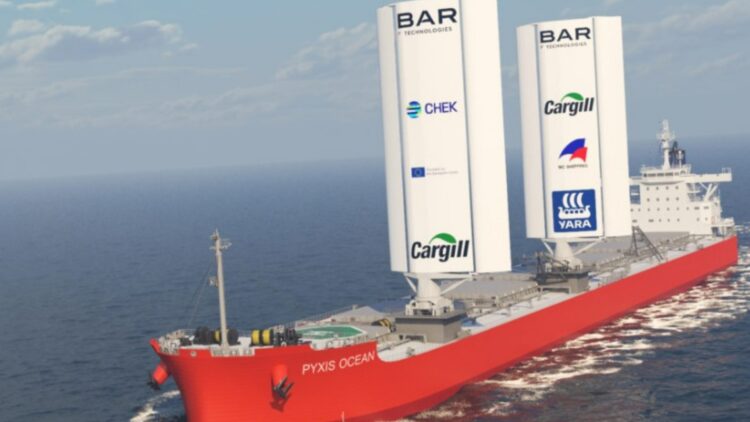
Large ships (whether cargo or passenger) never have sails, right? They are always powered by fuel (which does not sound illogical in 2025, right?). Well, now one crosses the ocean powered purely by wind, like in the old days, no fuel (and no pedals either), but they have actually tried it.
It is called Pyxis Ocean, and it is the world’s first cargo ship that sails with sails, rigid and automated, but still sails. And it has managed to reduce fuel consumption by 11 tons per day. High technology, and on top of that, stylish, what more can we ask from technology?
And if we think about how much pollution maritime transport produces (millions of tons of CO2 every year), this sail-powered ship idea seems truly innovative. We will explain everything so you can understand what the Pyxis Ocean really is.
Full speed ahead, with all sails up!
The system is called WindWings, and it was developed by the British company BAR Technologies. It makes use of something classic, sailing with the wind. But of course, classic with an update, because there is plenty of the 21st century in these sails.
To start, these sails are not made of fabric but of rigid structures that move on their own according to the direction and strength of the wind. They have sensors that adjust them automatically, always looking for the most efficient position to properly propel the vessel, reducing the load on the engine (and therefore, emissions).
So, it is something like a hybrid between a traditional ship and a wind-powered one, and this combination means it does not lose speed or operability (and no, there are no delays on these ships!).
Simple but impressive
The WindWings are incredible because they are versatile, there is no need to build a new ship to install them, as they can be added to vessels already in operation.
So, no smoke and mirrors here, it is a practical (and realistic, above all) solution. If more companies adopt this system, the reduction in emissions could be massive and almost immediate.
The sea has its problems too
Of course, it is not that simple. Many ports are not yet prepared to receive ships with sails of this size; everything has to adapt gradually (spaces, cranes, containers…), and of course, regulations need to be updated.
The maritime sector is one of the most conservative in the world, and changing something this big might take time…
Even so, the Pyxis Ocean has proven that it is possible to make progress without sacrificing efficiency or speed while reducing polluting emissions.
The future blows in favor of the wind
Imagine if the use of these sails became widespread, global maritime transport emissions could be reduced by up to 30% per year! And all thanks to artificial intelligence and the technology behind these sails. The future suddenly seems less scary!
These sails combine the past and the future, and it seems they make the perfect pair to board a ship, don’t you think?
So, the proof that sustainability and innovation can go hand in hand has a name, it is called Pyxis Ocean. If many more shipping companies followed this example, we could be witnessing a new era in maritime transport, and the wind would once again move the world, but this time, with much more precision.
Who would have thought… the future of navigation would mean looking to the past!
Wind-Assisted Propulsion is where old meets new, using power drawn from the wind to help move the ship on its journey, saving fuel along the way.https://t.co/bPlZgXEB6Z
— SlashGear (@slashgear) November 3, 2025