
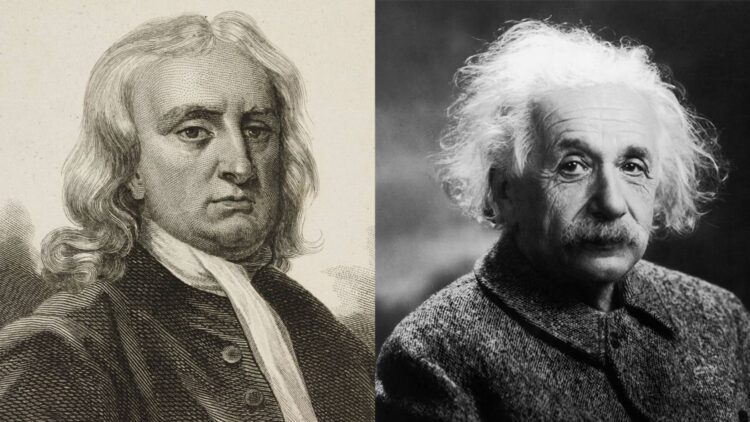
A South Korean scientist questions Newton and Einstein about gravity. For centuries, Isaac Newton and Albert Einstein’s theories have influenced our way of understanding the universe. Newton’s Law of Universal Gravitational laid the foundation of modern science, and later Einstein revolutionized that vision with his Theory of General Relativity. Both have been paramount in physics.
Now, a new South Korean study suggests that there can be limits on both theories when applied to certain cosmic systems. Researchers from the Sejong University have found results that question what was known as certain and point to gaps in how gravity is explained.
The view of the South Korean study
The South Korean team focused their investigation on a special type of star system known as wide binaries. This is a pair of stars that orbit among themselves at great distances and to analyze how they move, scientists can test gravity’s behavior in conditions where accelerations are extremely tiny.
In total, they analyzed 26,500 binary systems located less than 650 lightyears from Earth. This huge database allowed comparing stars’ movement to what Newton and Einstein’s theories predict.
What South Korean scientists discovered
The results were shocking because the orbital behavior of these stars didn’t completely coincide with what both theories anticipated. Particularly, the observed accelerations were very low, around 40% higher to what Newton and Einstein’s results suggested. Basically, when two stars orbit each other under weak gravitational forces, movements did not align with the formulas that science has trusted for hundreds of years.
The role of dark matter
A possible explanation proposed by the South Korean team is the influence of dark matter. Even though it is invisible, it is believed it is most part of the matter of the universe. It interacts through gravity and could be causing these unexpected results in star movements.
Researchers also connected their findings with the so-called Modified Newtonian Dynamics (MOND), an alternative approach that tries to explain anomalies in the galaxies. According to the study, this model could also be applied to wider binaries.
What does this South Korean study matter?
Newton and Einstein’s work is still essential, their theories explain phenomena: from the motion of planets to the bending of light near massive objects. However, the South Korean research shows that there could be contexts where these laws weren’t enough.
Discovering such gaps does not erase centuries of progress, but proves how science works: theories are tested over and over again, and when new data shows up, they have to be adjusted or expanded. Sejong University findings remind us that our knowledge about gravity is still incomplete.
The future
If these results ended up being confirmed, they could change the way we think about the universe. Gravity is one of the 4 fundamental forces of nature, and any adjustment to its laws would have deep consequences.
For now, South Korean observations lead to more questions than answers. Future investigations should clarify if dark matter, the MOND and other unknown factors explain these differences. What’s for sure is that the observed stars don’t behave exactly like Newton and Einstein predicted.
A step forward in science
The South Korean study, published in the Astrophysical Journal, is not a rejection of genius like Einstein or Newton, but a step forward in understanding. It shows that even important theories have limits and that it’s always possible to find something new to observe the universe in detail.
Some people might think that questioning genius is very brave, but the truth is that thanks to these South Korean scientists we can have a better understanding of concepts we already ‘’knew’’.