
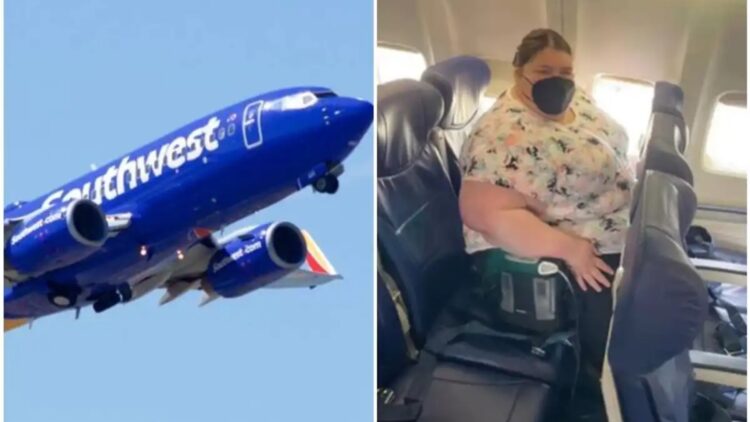
Flying can be difficult for some people, and changing rules can be confusing. But, Southwest Airlines has recently announced a new important policy that will affect some passengers from January 2026. With this measure, the company wants to improve comfort, safety, and consistency. However, this can also change the way in which certain passengers must buy their tickets. So, let’s explain what Southwest Airlines is changing.
Southwest Airlines change
From January 27 of next year, Southwest Airlines will demand some passengers buy two seats instead of one. This applies to passengers who cannot sit comfortably within the space of a single seat, meaning they cannot fit between the armrests without using part of the neighboring seat. According to the airline, the armrests will now be considered the official boundary of each seat.
This measure will be compulsory in every Southwest Airlines flight and it will replace the previous measure, which was more flexible.
The previous measure v. the new measure
Before this change, Southwest Airlines had a policy called ‘’Customers of Size’’. Under this rule:
- Passengers could request an extra seat.
- They usually paid for it first.
- After the flight, they could ask for a refund for the second seat.
This policy was considered the most flexible in the U.S., but the process will be different with the new policy:
- Passengers must buy two seats at the time of booking.
- Both seats must be paid for in advance.
- Refunds will no longer be automatic and will only be available in specific cases.
Refunds
Southwest Airlines confirmed there will be refunds, but the requirements will be stricter. Refunds for the second seat will be only possible when all these rules are followed:
- The flight was not completely full.
- Both seats were purchased under the same fare
- The refund request is made within 90 days after the flight.
If only one of these conditions is not met, the refund won’t be approved.
What’s more, the airline also stated that the armrests will be the official limit, but it didn’t exactly explain how ‘’comfort’’ will be valued, something that is confusing many passengers.
What if someone doesn’t buy the second seat?
If you arrive at the airport without buying the extra seat and the plane is completely full, Southwest Airlines could:
- Change you to another flight.
- Delay or unexpectedly change the schedule.
Tickets and seat assignments changes
Another important detail is that the new rule will apply across all sales channels, including: Online bookings, call centers, and airport ticket counters. So, passengers will no longer be able to handle this situation only during boarding or after the flight.
At the same time, Southwest Airlines will also end its long-standing open seating system on January 27, 2026. Instead of choosing any available seat after boarding, passengers will receive assigned seats in advance, similar to most other airlines.
According to the airline, this will help better organize flights and will allow passengers who need more space to plan properly.
Other recent changes
This new policy is part of a broader shift within the company. Southwest has already:
- Started charging for checked baggage.
- Ended its famous “Bags Fly Free” policy.
- Announced future charges for seats with extra legroom and other services.
The airline defines these changes as a modernization strategy to improve the income in a very competitive market.
This is common in the U.S. airlines
Southwest Airlines joins this way other U.S. airlines that already apply similar rules. Some of these airlines are:
- American Airlines.
- United Airlines.
- Spirit Airlines.
- Frontier Airlines.
Experts point out that these decisions are done for both safety reasons and economic pressures.
To sum up
Starting in 2026, affected passengers will need to reserve and pay for an additional seat in advance, with refunds only possible under specific conditions. Combined with assigned seating and new fees, this marks a major shift in how Southwest operates.
For travelers, understanding these changes ahead of time will be essential to avoid surprises and travel disruptions.