
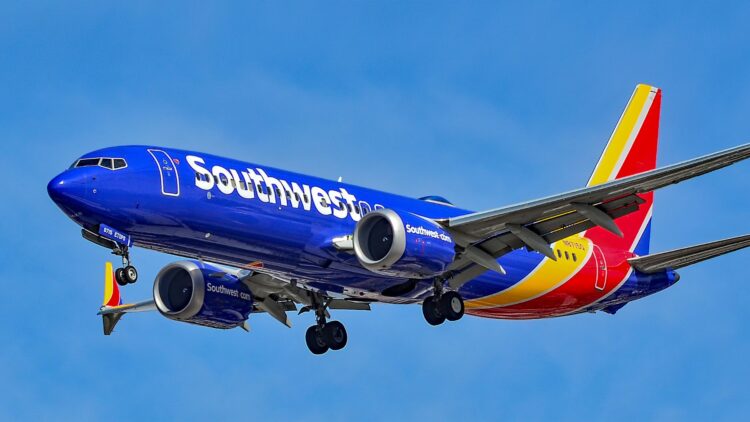
Southwest Airlines has just announced news that has left us stunned: it will stop offering free checked baggage starting on May 28. Only passengers with Business Select fare will still be entitled to two free bags. The rest will have to pay for each additional item, marking the end of one of the airline’s historic advantages and putting it on the same level as its competitors. One of the things that made this airline stand out was its allowance of free baggage, thus reducing travel costs, but now… According to its own calculations, they expect a 30% drop in the number of checked bags, which also predicts more chaos during boarding due to the increase of passengers trying to bring more luggage into the cabin.
With this decision, Southwest is moving away from its traditional model and joining the strategy of extra fees that other airlines already apply. The change will affect millions of passengers who, until now, chose this company specifically to avoid extra costs…
Goodbye to free checked baggage
For years, Southwest was an exception among U.S. airlines; this airline allowed two checked bags free of charge, even on basic fares, something that made it one of the top favourite airlines for mid-level travellers (because we like to save, of course). But that will no longer be the case. And although they do not openly admit it, they know the change will complicate boarding and might even reduce the number of travellers.
The company’s own executive vice president of operations, Justin Jones, has acknowledged that many passengers will try to carry everything into the cabin. And that will require checking in bags at the last minute, right at the airplane door, causing delays in departures.
What changes if you fly with Southwest
The policy is clear: starting on May 28, if your fare is not Business Select, you will pay for checked baggage. So, it’s time to review what you can bring into the cabin for free.
What can you bring on board without paying?
And be careful, because the cabin bag can’t just be any bag, it will have a size limit. Each passenger can bring:
- A carry-on bag that fits in the overhead compartment (up to 60 x 40 x 25 cm).
- A personal item under the seat: small backpack, purse, laptop, or blanket (neck pillows will not count as a personal item).
Anything that exceeds these dimensions will be checked in, and this time, with a fee. So, if you don’t want to be surprised at the boarding gate, it’s better to measure and weigh everything before leaving home.
Southwest admits the change may cause delays
The company is aware that this decision may have immediate effects on operations. When dozens of passengers try to fit large bags into the cabin, the compartments will become overcrowded, and bags will need to be checked at the last minute.
This will slow down boarding and may cause delays. Although they say they are working to minimize the impact, it’s a problem already faced by other airlines, with frustrated passengers having to part with their more personal luggage just before boarding (and the subsequent wait at the baggage claim carousel…)
Why are they doing this now?
The reason, as almost always, is economic. Airlines are still looking for ways to improve their profitability after the crisis caused by the pandemic. And charging for luggage is a direct and constant source of income, even though it may not seem very logical to us as users.
Southwest knows this measure won’t be popular, but they believe it is necessary. Their bet is clear: fewer bags in the hold, more efficiency on the ground… and more revenue per passenger (as always).
The Southwest advantage is over
For years, the free baggage policy was one of the main attractions for flying with Southwest, but now, starting this May, that will no longer be an argument. How will this bet go for Southwest? We’ll have to wait and see.