
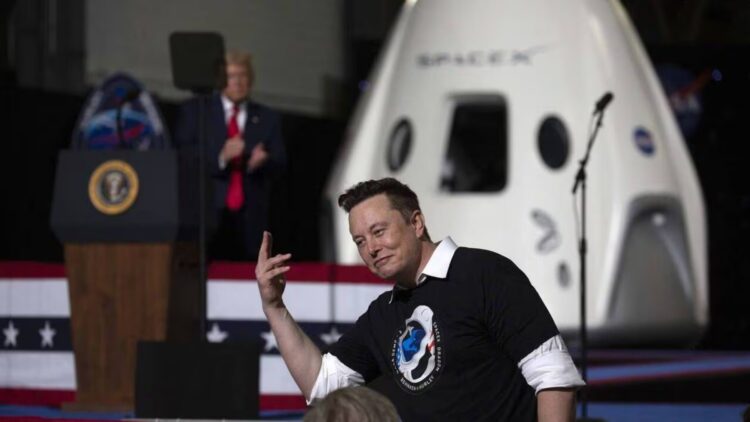
SpaceX and the U.S. government are a little tense, just a bit… It all started after Donald Trump threatened to break the contracts with Elon Musk’s company (they don’t seem to be such good friends anymore). Both NASA and the Pentagon have started to move to look for new solutions that help them develop rockets and spacecraft more quickly.
Musk himself hasn’t stayed quiet and has confirmed that, if the agreements are cancelled, SpaceX would stop operating its Dragon spacecraft, which would mean that the United States would be left without an immediate way to send astronauts to the International Space Station, wow. Are there real alternatives to SpaceX?
The direction of space exploration
Currently, NASA fully relies on SpaceX to carry out its missions and, even though Musk took back his threats… it seems that the tension is here to stay. Was Trump’s move a political manoeuvre?
Musk’s response worsens the situation
Musk is a natural provocateur, and he wasn’t going to stay quiet even with his “friend” Trump, so he quickly responded. His warning that SpaceX would stop flying the Dragon spacecraft if the contracts were broken was seen by the aerospace community as a high-risk move. That spacecraft is currently the only vehicle capable of transporting astronauts from U.S. soil to the International Space Station (ISS), so if SpaceX stopped operating, the lives of the seven astronauts currently on the ISS would be at risk.
For many NASA and Pentagon officials, the “beef” between Trump and Musk initially seemed funny, but once the Dragon threat was out, everything became terrifying when they realized it wasn’t just a threat.
What other options does the United States have?
None. It’s complicated to understand but, there are no other options… Jeff Bezos’s Blue Origin is still in the development phase for manned flights and is not capable of carrying out those trips for the moment. On the other hand, Boeing, with its Starliner capsule, has faced multiple delays and technical failures… It’s not an option either… Rocket Lab and Firefly Aerospace are making progress, but their vehicles are not yet ready for large-scale missions, so…
So no, we need to keep Musk happy (even if we don’t like to), because it’s not the first time Musk has threatened to cancel a space mission. Back in 2018, NASA requested an investigation into SpaceX’s safety after he gave an interview to Joe Rogan…
But now, now it’s much more complicated, and the NASA station has cost over 100 billion dollars, and the fact that he is able to put all space research at risk because of his impulsiveness says a lot about him…
NASA and the Pentagon take action
People from NASA and the Pentagon have stepped up their efforts to pressure other companies to speed up the development of alternative systems. Even until now there haven’t been issues with relying only on one private company… it doesn’t seem like the best option after this incident.
Full SpaceX dependence: Risk or solution?
It’s not just about rockets: there are also contracts related to defense, satellites, and planetary exploration missions at stake, and maybe that shouldn’t be in private hands exclusively.
And the competition?
While there are companies with technological capability (or at least trying it), all of them are far from reaching the operational maturity level of SpaceX (remember they have a full space system created).
That’s why the government has started to offer more financial and technical support to these firms, hoping that at least one of them can be ready to fill the gap if Musk decides to cut ties.
A possible turning point for the future of U.S. space
This crisis could mark a before and after. It makes clear that a nation cannot rely exclusively on one company (no matter how efficient is) to maintain its presence in space. But, of course it shows that the public-private collaboration model needs adjustments to guarantee the country’s safety and autonomy.
Musk’s strategic dilemma
Elon Musk knows that SpaceX is essential today, but he also knows that this dominance is under threat. His warning has had the opposite effect from what he might have wanted: it has set off all the alarms in Washington and has sped up the diversification process that used to seem slow and bureaucratic.
For now, the most likely scenario is that the current contracts will remain in place. But it is clear that the government doesn’t want to keep relying only on SpaceX. If tensions continue, everything could change in the U.S. space scene in the coming years.