
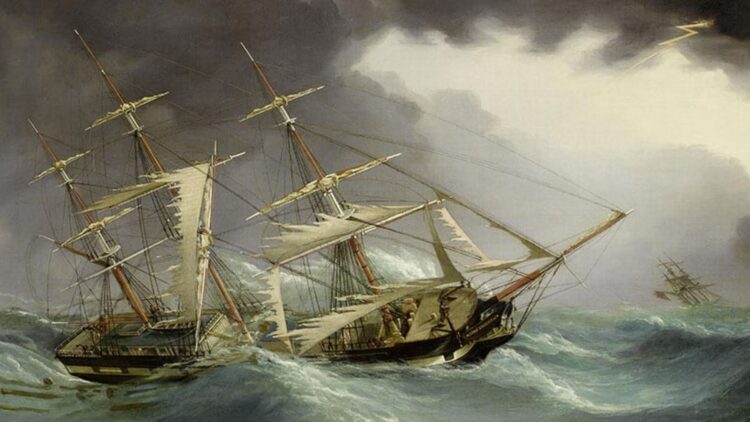
Do you know the connection between Jesuit priests and hurricane predictions? It goes back to the 19th century, more than 100 years ago, when Spain had colonies in places like Cuba and the Philippines. At that time, hurricanes caused many problems: they destroyed houses, ships, and left many people with nothing. There was no way to know when they were coming, but this changed thanks to teamwork between the Spanish Navy and some Jesuit priests, who were also scientists.
Now, it’s a totally different process, but back then they created a system to predict hurricanes using sky observations, special instruments, and a lot of organization. It was one of the first scientific methods in the world for doing this which is completely different. So, let’s learn more about this story.
What the Spanish sailors did
For a long time, starting back in 1575, when King Philip II made it a rule, Spanish sailors wrote down everything they noticed about the weather (winds, clouds, storms, and the paths their ship followed) in a special notebook called a logbook.
With the passage of time, sailors were quietly gathering clues about the sky and sea while sailing across the oceans by using barometers to measure air pressure and thermometers to check temperatures.
And Jesuits?
They were priests, but they were also fascinated by nature. They had weather stations to observe the sky and get information about clouds, the wind, air pressure, and even the Earth’s invisible magnetic pull. Where? In places like Havana and Manila. They did all of this because they believed the weather could help them understand how everything in the universe fits together.
Father Benito Viñes
Benito Viñes was in charge of the Belén Observatory, and in 1875, he gave the first public hurricane warning by carefully observing the cirrus clouds, which he called “rooster tails.” He believed these clouds appeared before a hurricane. However, to improve predictions, he asked ship captains to observe and write down what they saw. So, with all these notes from different places, they could trace the hurricane’s path.
Instruments used
Apart from looking at the sky, Viñes and his colleagues also used scientific instruments, such as:
- The Secchi meteorograph, which automatically recorded weather data.
- The cyclonoscope, for observing cyclones.
- The aneroid barometer by Faura and the barocyclonometer by José Algué, which helped sailors know how far away a typhoon was and which direction it was moving.
But what mattered most was not just the instruments—it was how they connected all the information. The Jesuits looked for relationships between what happened in the sky, air pressure, and magnetic fields. They wanted to find repeated patterns to be able to predict what was going to happen.
Viñes’ laws about hurricanes
In 1895, Viñes wrote a book where he explained his ideas about how hurricanes spin and move. For example, he said hurricanes had several layers of air: a lower part that moved inward, a middle part that spun, and an upper part that moved outward. What’s more, he also explained that hurricanes follow a curved path (like a parabola), and that it depends on the latitude and time of year.
Thanks to this, they could predict if a hurricane was going to change direction, be delayed, or disappear.
Science to help people
One of the most important parts of the Jesuit method was that they did science to help people. The goal of Viñes’ work on hurricanes was to protect lives and property in the colonies.
The observatories were part of Jesuit schools and open to the community. They shared what they learned with sailors, farmers, and local authorities, at a time when natural disasters were a constant threat.This story shows how careful observation and teamwork helped people predict hurricanes for the first time.