
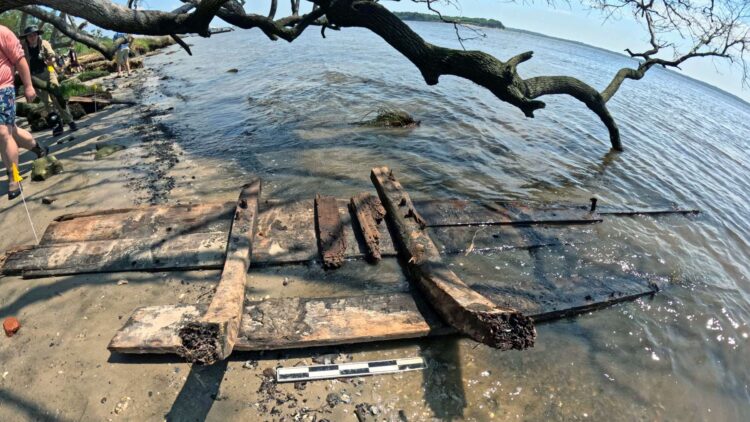
Have you heard about the mysterious Spanish ship found in the depths of a river in North Carolina? A group of archaeologists have found remains of this Spanish ship, which it’s believed to be a Spanish warship that sank in 1748. This is not the first time an ancient ship is found underwater, but this finding is rewriting part of colonial history. So, let’s find out more about what this means and this Spanish ship story.
What scientists found in detail
This finding was seen in the Cape Fear river, a swampy place where the water of the river is mixed with the Atlantic Ocean. There, archaeologists found more than 40 pieces of wood in great condition and it was proven they were cypress from Mexico, a type of tree used in the 18th century in ships from Spanish territories in the Americas.
This clue, next to the location of the wreck and the presence of a canyon from 1985, seems to be an open door to think that the remains belong to the feared Spanish corsair La Fortuna.
Let’s talk about the context
It’s important to talk about September 1748 to understand the importance of this Spanish ship. In this era, the War of King George was raging, pitting Great Britain against France and Spain.
The Spanish corsair La Fortuna sailed from Cuba to attack the British colony of Brunswick, a thriving port in North Carolina. The Spanish sailors landed and briefly took over the town and local militias fought back, sparking an intense battle. Then, the attackers were forced to retreat to their ship, firing cannons at the colonial defenses.
Suddenly, a massive explosion destroyed the ship, killing the captain and most of the crew. The treasure recovered from the wreck was later used to fund two colonial churches, one in Brunswick and another in nearby Wilmington.
Not 1, but 4 ships were found
The most surprising thing was that researchers found more than La Fortuna, there were three more wrecks in the same area of the river along with old wooden docks and even a colonial road. So, let’s talk a bit about them, shall we?:
- One of the ships seemed to have been used as landfill for building docks.
- Another was likely a flat-bottomed colonial vessel for carrying goods and passengers.
- The fourth wreck remains mostly buried and is still a mystery.
Thanks to these remains, archaeologists can rebuild how life was in Brunswick before it was destroyed by British troops in 1776.
Running out of time
However, not everything is great because these remains are threatened by erosion, storms, and channel dredging. That is why researchers did an emergency recovery mission. What they basically did was take the wood they found to the Queen Anne’s Revenge conservation lab in Greenville. Once there, it will be subjected to a special treatment to stop its deterioration so that researchers can rebuild part of the Spanish ship, and who knows if they could display it in a museum?
Why is this Spanish sip so important?
Every finding is a new learning about the past, but this one reminds us that the history of North America wasn’t just about the British and French people. As you can see, Spain also had an important role in the era with docks, colonies, and corsair ships sailing the Atlantic.
The case of La Fortuna shows how Spanish corsairs fought for control of trade routes, and how small colonial communities defended themselves. It is a forgotten piece of history that is finally resurfacing. Isn’t it fascinating how much we can discover from the remains of an ancient ship?