
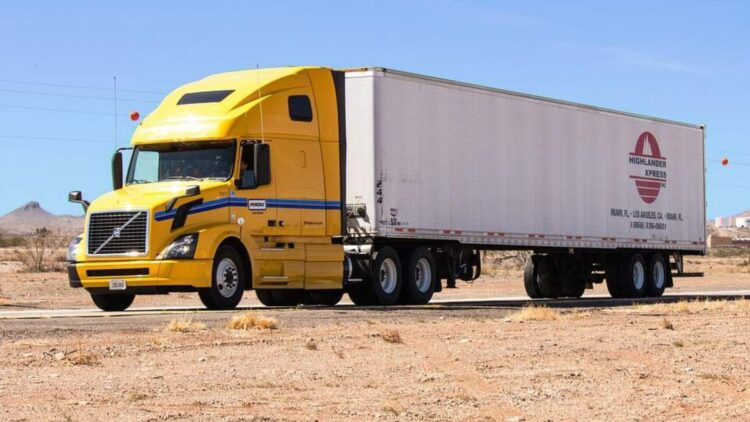
Remember when we talked about how they were going to install speed limiters in many places across the country? Well, you can delete that info from your head because the Federal Motor Carrier Safety Administration (FMCSA) has decided to backtrack on this proposal, which mainly affected heavy commercial trucks.
So yes, they’ve decided to hit the brakes (no pun intended) with the executive order signed by President Donald Trump. The debates that had been going on since 2016 are now over! Some people even had hair when this started being discussed! But of course, like everything else, it’s opened new debates. Here’s everything.
What was the FMCSA proposing?
The idea was to require that all new trucks weighing more than 11,793 kilos be equipped with a system to cap their maximum speed. The range being considered was between 60 and 68 miles per hour (roughly 96 to 109 km/h), with no option for the driver to exceed it, not even under safe conditions. And once installed, that limit would stay forever.
In 2022, they tried to revive the topic, suggesting that interstate transport companies get on board with all their heavy vehicles. But no consensus was reached. What seemed like a safety initiative ended up buried under a pile of criticism, legal conflicts, and unclear numbers.
State vs. FMCSA
One of the big issues was the clash between state and federal authority. Many states allow speeds above 68 mph on certain stretches, especially in rural areas. If the rule had been approved, the federal law would have overridden those local decisions. And as expected, that didn’t go over well.
On top of that, there wasn’t enough data to clearly support the measure. Sure, it was estimated that around 214 deaths could be avoided each year, which is not insignificant. They also calculated savings of up to $1.56 billion annually in operating costs. But those figures were full of asterisks and unconfirmed assumptions. Too many unanswered questions.
Lack of clarity
Dan Horvath, VP of operations at the American Trucking Associations, said that this cancellation “was expected” and aligns with the current administration’s policy. Trump’s executive order requires that two regulations be eliminated for every new one introduced, and this one fell under that cut, just like that.
During the review periods, over 22,000 public comments were submitted. And it wasn’t a clear “yes” or “no.” There were opinions of all kinds: some supported parts of the proposal, others rejected it entirely, and even among truckers there wasn’t a unified stance.
If there’s no limit, what is there?
Jajan’t. Although the speed limiter is no longer mandatory, it doesn’t mean everything is left to chance, hopefully. Agencies are relying on current technologies like automatic emergency braking and forward collision warnings to make up for the risk. Many trucks already come with these systems as standard, and the idea is that safety will come from there and from drivers’ own responsibility.
Even so, not everyone is convinced. Giving up direct speed control could backfire in the long run if inspections aren’t reinforced or if those assistance systems aren’t properly maintained.
For now, the debate is on full stand-by. Trucks will continue running without a federally imposed speed limit, and we’ll just have to hope nothing bad happens. Who knows what this government’s next move will be?