
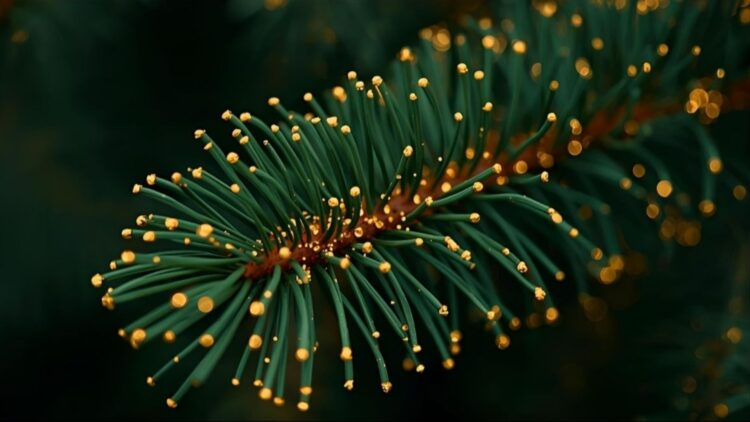
The spruces of Finland have gold in their leaves. And although it may sound like a Nordic legend you would hear one day by the fire in the middle of a forest roasting marshmallows, we are not lying to you, science has just confirmed it. But not all spruces have gold, only the red spruces (those immense, silent giants that shape the Finnish landscapes). And it’s not like you can pull a gold chain out of their leaves, but they can accumulate it thanks to tiny microbes found under the bark of these trees.
The discovery was made possible by the University of Oulu and the Geological Survey of Finland (GTK), and many are already talking about the beginning of a new era: the era of green mining.
The gold that grows in the treetops
The experiment was carried out at the Tiira gold deposit in the north of the country. The scientists took 138 samples of red spruce needles from 23 different trees, and in four of them, they found gold nanoparticles inside the leaves.
We might think it was surface dust or signs of contamination, but no! It was gold, woven inside the tree, integrated into its structure, as if it were part of it. And it was surrounded by bacteria that act like tiny natural laboratories, wow!!!
These bacteria (Cutibacterium, Corynebacterium, and a mysterious group called P3OB-42) live inside the tree and have the ability to transform gold dissolved in the water of the soil into solid particles, as if the spruces were producing gold from within.
“The most fascinating thing is not the amount of gold, but the process” explained one of the GTK researchers. “This completely changes what we thought we knew about how trees interact with underground minerals”.
Trees as natural alchemists
Plants have always absorbed minerals from the soil; that was already known, it’s nothing new, but what is new is discovering that it is the microorganisms inside them that make the miracle possible.
These bacteria (endophytes) turn minerals into solid nanoparticles. And although the value of the gold in each tree is minimal (barely 0.02 euro cents), the scientific value is enormous.
Mainly because this could lead to using trees as natural mineral detectors, without the need to drill the ground or disturb ecosystems.
Imagine walking through a forest and, instead of searching for gold underground, analyzing the leaves. If they contain traces of the metal, there could be a deposit below. Simple, ecological… and almost poetic.
Green mining
Can you imagine a model of sustainable mining? Well, it could be possible. This type of mining seeks to reduce the environmental impact of traditional excavations. And this technique (based on trees and microbes) could be the first step.
Scientists believe this approach will unite disciplines: ecology, microbiology, geology, and nanotechnology, and the result could be a new way of exploring underground, cleaner, more precise, and less destructive.
Nature and science join hands
Spruces are symbols of strength, and now also guardians of gold. Those microbes that we cannot see with the naked eye are the silent alchemists that create this “magic”
The future of mineral exploration?
For now, the research is still in the experimental phase. But the results, which have been published in the journal Environmental Microbiome, are already raising eyebrows. The Finnish team already plans to expand the study to other types of soil and climates to see if the same phenomenon can be reproduced in different regions. Wouldn’t that be interesting?
But beyond that, the real goal is to create a non-invasive method to map underground mineral deposits. To analyze leaves and not drill mountains, can you imagine?… If they achieve it, we will be facing a model where nature is not destroyed to seek wealth, but cooperates to find it!!