
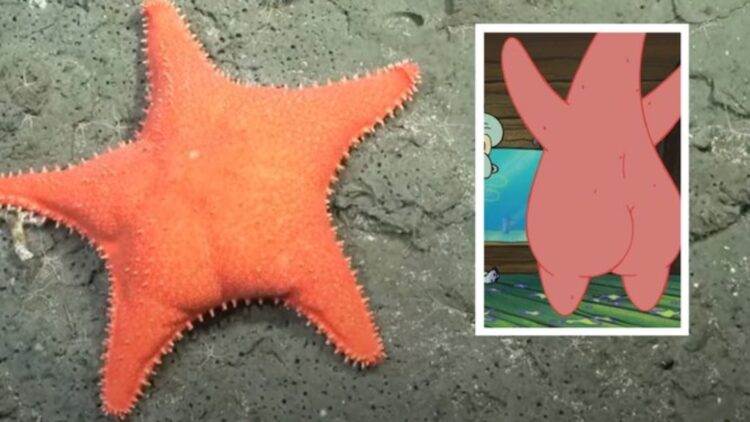
We have heard about shocking underwater discoveries, but this starfish has shocked scientists. Recently, a group of researchers were exploring the South Atlantic and they found more than 40 never-seen species, including a very curious starfish that went immediately viral because of its similarity to a cartoon character.
I’m sure you know which character we are talking about, it’s… Patrick Star from SpongeBob SquarePants! So, let’s learn more about this starfish and what scientists found in the deep ocean.
A starfish like Patrick Star
During an expedition in Mar del Plata submarine canyon, located more than 4,000 meters deep, a robotic vehicle called SuBastian transmitted live images of never-seen creatures. Among them one stood out the most: a starfish from the Hippasteria family. It had a rounded body and short arms, which seemed almost human if looking at its shape.
The funny thing is that this starfish was very familiar to many people since it was so similar to the cartoon character Patrick Star from the SpongeBob SquarePants show. So, you can imagine the many jokes and comments on social media…
Although its appearance was so appealing to the people, scientists thought this shape could have an adaptive meaning: maybe it helps the starfish to better stick to surfaces or store energy in an environment where food is scarce.
More than 40 species
Of course, it’s funny to find this kind of starfish that looks like a cartoon character, but we shouldn’t just acknowledge that because this was just a small part of a huge mission. Researchers found more than 40 new species in the region such as:
- Carnivorous sponges that trap prey with fine filaments.
- Translucent fish whose organs are visible through their skin.
- Colorful corals that looked like glowing sculptures in the dark.
- Strange crustaceans adapted to life in untouched deep-sea sediments.
This finding shows that, even in extreme depths, life finds its way to prosper and the submarine canyon area is a truly oasis of biodiversity.
A hidden world
The South Atlantic, in front of the coasts of Argentina, hasn’t been explored as much as other oceans. I mean, going more than 4 km deep is like going to another planet: no sunlight reaches there, temperature is near 0 degrees, and the pressure is so strong that it could smash any living thing that is not able to adapt.
However, thanks to the robotic vehicle SuBastian, it was possible to go through this ‘’out of this world’’ landscape and share live images with thousands of people around the world. What we could see was as if taken from a science-fiction movie: ghostly fish drifting like shadows, crystal-like corals, and a starfish posing for the cameras (which became the star of the expedition).
Importance of these species
We know the starfish stole the show on social media, but scientists highlight the real value is in the science behind this expedition. Each new species discovered represents a key piece of the puzzle of deep-sea ecosystems, which are essential for:
- Regulating the carbon cycle, which impacts Earth’s climate.
- Maintaining marine balance by supporting food webs.
- Providing unique biochemical compounds with potential uses in medicine and biotechnology.
Science and curiosity
The image of the starfish ‘’Patrick’’ reminds us that science could also be funny, it’s not all the time so intense and serious. As it went viral, this creature helped thousands of people know about the importance of the deep oceans and the need for protecting them.
What’s more, these types of discoveries show that there’s still a long way to explore on our planet. The incredible thing is that researchers are finding treasures we didn’t know of that are right here, on Earth.